



Fiction: This is an original fictional story. Characters and events are invented.
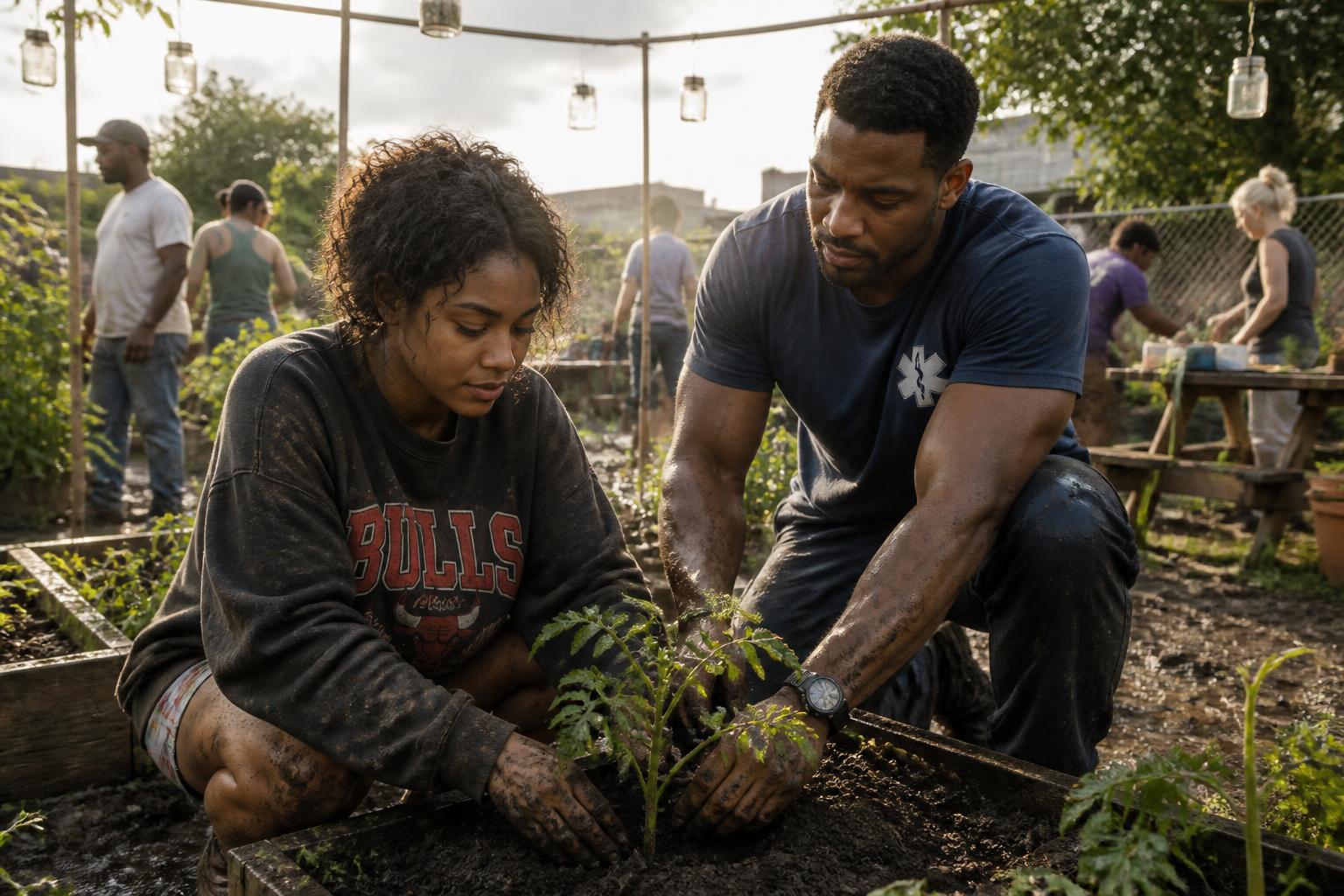
The rain finally eased, but Durham still shimmered in the dense hush that followed the worst of the storm. Downtown, abandoned umbrellas stuck out from trash cans like broken wings, and a branch blocked half the street outside the Meadowbrook Hardware. Jamie Lennox parked her battered Corolla nearby, wiping sweat from beneath her curls as she squinted at the hunk of debris in her backseat—a jagged window frame that used to be part of her kitchen. Her shoes sloshed. She tried to muster energy, but knew she looked like she’d crawled through a wind tunnel in pajama shorts and an ancient Bulls sweatshirt.
Inside the hardware store, backup generator lights buzzed overhead. The place thrummed with strangers: neighbors seeking tarps, buckets, plywood. Jamie grabbed a cart and started her list. Duct tape. Gloves. Extension cord. She resisted the urge to call Lena—her roommate had spent the morning bailing out their kitchen, and needed a nap more than sympathy texts. Every muscle ached. Somewhere behind her, two kids squabbled over the last flashlight, a dog barked, and someone in a raincoat cursed softly as paint cans tumbled to the floor. Chaos, but also Durham at its realest—neighbors showing up, patching up together.
Jamie rounded an aisle, nearly ramming her cart into someone else’s. Instinctively, she apologized, then stilled. The tall figure stared at her, water-dark curls plastered to his forehead, a blue paramedic shirt barely dry. For half a moment, Jamie wondered if she was hallucinating from stress. But she couldn’t imagine Malik Carter—her Malik, the boy from next door, long vanished—anywhere else but here, rain or not.
For a few heartbeats, neither moved. The world shrank to the wobble of the shopping cart and the flickering lights above.
“Jamie?” Malik’s voice slipped out—raspy, almost hopeful. He looked older, jaw dusted with stubble and tired in a way she’d never seen twelve years ago. But those eyes, always quietly searching, sparked behind the exhaustion.
She managed a nod, pulse skipping. “Hey, Malik.” It sounded too casual, so she let silence fill the aisle. “Didn’t know you were still around.”
“Just in for the week.” He cleared his throat. “My dad—” he hesitated, gaze slipping away—“passed Sunday. I’m… handling things.”
Jamie’s breath caught. Mr. Carter had always been the neighborhood’s steady center: prodding kids into little league, fixing porch swings, laughing across fences. She started to offer something—a condolence, a memory—but Malik looked away before she found the words. She wondered, not for the first time, if this was just how things broke.
They both pointed at the box of contractor bags on the lowest shelf, hands nearly touching. Malik gave a wry half-smile, stepping aside. “Storm cleaning?”
“Yeah, my place lost a wall.” Jamie hesitated, then decided honesty was easier than small talk. “We’re getting evicted, probably. Just trying to keep it livable one more day so we don’t lose our stuff.” She meant for it to sound like a joke. It hung heavier than intended.
Malik frowned. “You need help?”
She shook her head, but the storm had wrung her dry. “Maybe. After I fix the power—my roommate, Lena, she’s back trying to stop the ceiling from leaking on her laptop.”
He nodded, an awkward beat stretching as a family squeezed past them, arms full of plastic sheeting. Rain drummed on the roof.
Malik hesitated—thumb running across the rough seam of the cart. “I’ve got a few hours. Was going to check on some old neighbors on Holloway after I grab stuff. If you want another set of hands?”
Jamie weighed the offer, glancing at the bags under his eyes, the way he stood with a heaviness she knew well; he probably hadn’t slept since Sunday. Still, pride tugged at her. “I guess we could do a loop—see who’s outside needing help.”
Minutes later, they walked side by side towards her car, Malik’s kit slung over his shoulder next to her carton of duct tape and paint. The air tasted metallic, leaves plastered to the sidewalks, robins picking through puddles. As they passed the old theater—roof peeled away by the wind—they found folks dragging wet carpets onto the curb. Jamie waved once, eager to move faster, but Malik slowed, already offering help. Soon, they bent to heave debris, falling into an easy, tired rhythm. They barely spoke at first, just grunted agreement, passing tools and hauling what the storm had broken. Old patterns emerged: Malik’s calm steadiness against Jamie’s scatter-brained determination.
Somewhere between dragging a ruined sofa and squeegeeing out a flooded doorway, Jamie risked a quick glance at him. All the unspoken years pressed between them like sticky humidity. She wondered if he remembered—rain on the porch steps, laughter under crepe myrtles, all those plans drawn in chalk that real storms had long since washed away.
By the time midday sunlight struggled through the ragged clouds, Jamie’s arms trembled from endless lifting and her shirt clung damply to her skin. The clusters of neighbors ebbed and flowed, the city coming out to survey the damage and share what tools they had, but always she circled back near Malik. There was something oddly comforting about their silence—like the hush that followed bad news, heavy but shared.
As they walked to Jamie’s apartment, Malik picked out a splinter and shook his head, half-smiling. “You still find trouble like a magnet, Lennox?”
She snorted. “I attract structural disasters now. Some upgrade.” But her voice softened with a memory that tasted half-sweet, half-sore.
The sight of her building made them both pause. Tarpaulins billowed under the tug of wind, and from inside drifted Lena’s sharp voice. Jamie hustled upstairs, Malik trailing with practiced EMT composure, though she caught him eyeing the cracks along the stairwell.
Inside, Lena perched on a milk crate, rubber gloves halfway up her arms and hair shoved beneath a baseball cap. She grinned fleetingly at Jamie, then looked with open curiosity at Malik. “You’re—uh—helping today?”
“Malik,” he supplied, offering an exhausted smile. “I used to live next door.”
“Durham’s basically a small town on days like this,” Lena said, eyes darting between them. Her tone suggested she sensed the undercurrents. She handed Jamie a bundle of wet kitchen towels. “The landlord says ‘emergency repairs’ but means ‘don’t call me until Monday.' So…short version: we’re on our own.”
They worked for another hour—bucket-brigade style—until Lena called a break. Jamie dropped onto the mattress she and Lena had dragged into the driest corner, feeling both grateful and bone-weary. Conversation drifted, somehow light for the three of them, until Malik checked his phone: another neighbor needing help, a few blocks over. He stood to go, hesitating by the door. “You coming, Jamie?”
Jamie offered Lena a questioning look. Lena just nudged her. “Go—I'll keep draining the pool formerly known as our kitchen. If you see someone with a sump pump, send ‘em my way.”
The next stop was the old Meadowview Community Garden—a battered lot where chain-link fences sagged and soggy cardboard signs still declared “Plant Here For All!” The previous night’s storm had thrashed everything, tearing up seedlings and scattering mulch over sidewalks. A handful of neighbors shuffled about, faces drawn, examining the flattened rows and piles of shattered pots at their feet.
The garden had been Jamie and Malik’s secret kingdom once. Flashes came back to her—she and Malik digging for potatoes, their laughter echoing across the rows, their promises that nothing would get between them. Promise, of course, had turned brittle when college loomed and Malik had vanished without a word. The hurt, long dulled but not gone, twisted in Jamie’s chest as she knelt to re-right a cabbage start swept from its bed.
Malik crouched across from her, gently pulling salvaged seedlings from a tangle of weeds. “Remember when we used to argue about tomatoes? Couldn’t tell a Cherokee Purple from a Brandywine back then.”
Jamie managed a smile, flicking mud at his boots. “I seem to recall you claimed carrots were fruit.”
Malik grinned, but the look didn’t quite reach his eyes. They fell into an uneasy rhythm, their hands busy but the air thick with the things neither voiced. Around them, neighbors swapped updates about insurance, repairs, where to find fresh milk. The garden’s longtime matriarch, Mrs. Briggs, limped over with coffee in mismatched mugs. She set them down on a cinder block and eyed Jamie. “Y’all come to work or just swap mud pies?”
Embarrassed, Jamie wiped her hands and glanced sidelong at Malik. “We’re here to help,” she said. Malik echoed her, and their voices tangled awkwardly.
As they re-set terracotta pots and gently dug in battered herbs, sometimes their hands brushed, and always Jamie could feel the fractures running between them. More than once, Malik started a sentence—”I was going to say—” or “Did you ever—”—and stopped, words catching like thorns. Each unfinished thought left Jamie just a little more raw.
Finally, as the sun dipped low behind the water towers, Malik straightened, stretching his aching back. He looked around at the bruised, mud-streaked lot, at Jamie’s determined profile in the late light. “Funny, isn’t it? We can put dirt and seeds back,” he murmured, “but some things…” He trailed off.
Jamie stared down at her hands, streaked with rich earth. “Some things you can’t just patch with duct tape.” The words tasted like old regret, and she wondered if Malik felt it, too—the ache of what they’d lost, and the strange hope that maybe something could still grow here again.
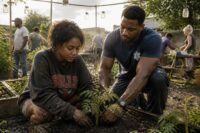
The last sullen rays of evening caught the battered fence posts as Jamie flicked dirt from her palms, pulse thrumming in her ears. Around them, the old garden’s patchwork tables had become a gathering spot for neighbors winding down—from Lena, fresh from another shift at the restaurant, to Mrs. Briggs, her weathered hands never still for long. The quiet hum of shared effort made it harder, in some ways, for Jamie to tamp down everything pushing in her chest.
She crouched by the tomato row, tucking a stem upright, feeling Malik’s presence behind her—steady, patient, waiting in the hush between lamplight and dusk. She looked up finally, voice choking, “You left like it didn’t matter. Didn’t even say goodbye.”
Malik froze, hands muddy. He let out a shaky breath, squatting beside her. “Jamie, I—I know. Back then, I thought if I talked to you about it, it’d make it real—more real than I could handle.” He looked down, tracing circles in the dirt. “My dad got sick. I didn’t tell anyone, not even you. The scholarship to State came through right then—couldn’t pass it up. I kept telling myself, ‘I’ll explain once I can make sense of it.’ But everything happened too fast.”
Jamie stared at him, unable to stop her voice trembling. “It wasn’t just the college. You stopped calling. Twelve years, Malik. I stopped waiting on phone calls, but I guess I never stopped being angry.”
He winced. “I messed up, J. I let it feel easier to disappear than to ask for help. My dad was proud—didn’t want our business out there. Hell, I thought I had to fix it all on my own.”
The streetlights buzzed awake. Someone lit citronella candles on the makeshift picnic table. For a while they spoke low, Malik sharing pieces Jamie had never heard: his father’s body failing, school feeling impossible, how being the one everyone leaned on left no air for his own panic. “I wanted to stay but I—I just couldn’t see a version where things didn’t fall apart.”
Jamie surprised herself by letting her hand rest by his. “For what it’s worth—I didn’t need you to be perfect, Malik. I just needed you to let me in.” She turned, blinking back tears. “After you left, I didn’t trust anyone. Not really. Even now it’s like…letting people close means risking the bottom dropping out.”
He met her gaze. “That’s on me. I’m sorry. I get if you can’t forgive it.” Jamie shrugged, the space between their knees suddenly not so wide.
Somewhere nearby, there was a yelp. Mrs. Briggs’ flashlight bobbed frantic. People hurried to the far end of the lot—Jamie and Malik trailing with wary apprehension. At the north fence, mulch scattered wide, the raised beds trampled and, in the center, a slashed plastic sign curled into damp grass. Someone had come through, sometime since dusk, and wrecked what little the storm had spared.
A muted anger settled over the gathered neighbors. Mrs. Briggs shook her head. “It’s not enough for the weather to hurt us. Now this…?” Others murmured, some defeated, others flat with shock.
Jamie blinked, gut burning. She looked at Malik, caught the same stubborn hurt behind his tired eyes. Without thinking, she gripped his elbow. “We’re not letting it end like this. Not after today.” She turned to face Mrs. Briggs, Lena, the whole bruised gathering. “We can fix this. Again. Tomorrow, we put it all back—together. I’ll call the restaurant crew, Malik can organize volunteers. We’ll get tools. Whatever we have to do.”
Her voice surprised even herself—tough, tired, but rising over the wind. Malik backed her up, his confidence steadying the group: “We know how to pull together. That’s the only way this city ever worked.” He started scribbling down lists, delegating jobs, even texting contacts from the firehouse and hospital.
The mood shifted. Lena clapped Jamie on the shoulder. Someone hauled out hot coffee. Plans bloomed right there, late into the blue-black dark, with Jamie and Malik shoulder to shoulder, patching hope together from the scraps. Old wounds throbbed, but as she passed Malik the battered flashlight, his hand lingered over hers. The night hummed with the knowledge that mending didn’t mean forgetting—it meant choosing to keep rebuilding, no matter what threatened to tear things apart.
By the following weekend, the Meadowview Community Garden felt less like a casualty and more like a resurrection. The damage of the storm—and the vandals—lingered at the margins, memories in muddy footprints and splintered boards, but the central beds throbbed with new green. People came in shifts: retirees with their own tools, Lena’s friends from the restaurant, kids in mud-soaked sneakers. Jamie’s hands cramped from transplanting tomatoes and coaxing basil to stand upright. Malik, no longer just visiting, directed volunteers in a paramedic’s clipped rhythm, pausing now and then to crack a joke or demonstrate how to untangle stubborn roots without tearing them. Durham’s sun was gentle, but determination made everyone sweat.
Lena watched Jamie from a distance, grinning as she rolled out a battered portable stove on the garden’s edge. “You need a break,” she called, tossing her a plastic container of roasted vegetables. “You’ve been replanting that same kale for twenty minutes.”
“It’s perfectly lined up now,” Jamie shot back, but she took the food and sat cross-legged on the mulch. Lena lowered herself near, and together they surveyed the haphazard miracle before them—neighbors laughing, Malik wrangling a dozen teenagers to finish building a new trellis out of scavenged wood, Mrs. Briggs leading a planting song in a voice that could shatter glass.
“This was a good idea,” Lena said warmly. “Pop-up dinners are your thing. Now we’ve got actual veggies again, you can do more than feed three people in the kitchen with one skillet.”
Jamie smiled, less self-conscious than she’d felt in months. “Didn’t know restoring a garden could make me feel like I actually belong here.” Her gaze drifted to Malik, who caught her eye and wandered over, brushing dirt off his knees.
He crouched beside them, easing tiredly onto the grass. “People are talking about making this official. Having you cater events. I heard Mrs. Briggs bragging you made the world’s best green beans.”
Jamie rolled her eyes, but pride snuck in. “She’s easily impressed.” She hesitated, searching for the shape of what their friendship had become—less fragile, more honest. “You staying?”
Malik nodded slowly. “Yeah. Took the job at the hospital—full-time. Turns out I’m not ready to leave. Not now.” His gaze held hers. “There’s stuff here worth sticking around for.”
Beside them, Lena whistled. “Well, looks like Durham’s keeping its stray sons and daughters.” She stood, stretching. “I’ll go see if Mrs. Briggs wants to conspire about carrot cake.”
The new trellis stood crooked but sturdy along the north fence. Lanterns made from old mason jars hung in its shade, flickering yellow as dusk settled in. Someone struck a chord on an old guitar. The air buzzed with the scent of crushed tomato vines and wood smoke and new hope. Around them, people gathered for the pop-up dinner Jamie and Lena had promised: tangy collard wraps, marinated cucumbers, cakes streaked with strawberries just picked from their resurrected patch. Laughter peaked and faded, cutting through the memories of waterlogged misery that once threatened to drown all of Meadowbrook.
Jamie slipped into a rare, unhurried calm as she watched Malik talk quietly with a teenage volunteer about EMT school, his eyes alive instead of tired. As the evening cooled, he found Jamie again, offering her a steaming cup of community garden mint tea.
He settled beside her, elbows touching. The good ache of hard work and the easier ache of things lost and regained hung between them, gentle now. “You know,” Malik said, voice low, “every time I left a place behind, I thought I couldn’t come home. Turns out, I was wrong.”
Jamie’s smile quirked. “Some places are just buried under a lot of weeds. Takes effort to find them again.”
He looked at her, unhurried. “And some people, too.”
The community garden filled up with the murmur of voices and low music. Lanterns glowed. Jamie’s breath eased. She let herself lean into Malik’s shoulder, neither forgiveness nor promise—only that same stubborn hope that rebuilt broken ground into new roots. Maybe they weren’t the people who’d dreamed under crepe myrtles, but they had weathered the real storm: together, fragile, better, and entirely new.
“Second chances don’t start from scratch,” Malik murmured, as if reading her thoughts. “They just grow over old ground.”
Jamie looked out at the faces—their neighbors, friends, her own reflection in Malik’s steady gaze—and nodded. Here, amidst new shoots and familiar hands, the storm’s scars would feed the next season’s harvest. Here, they could begin again.