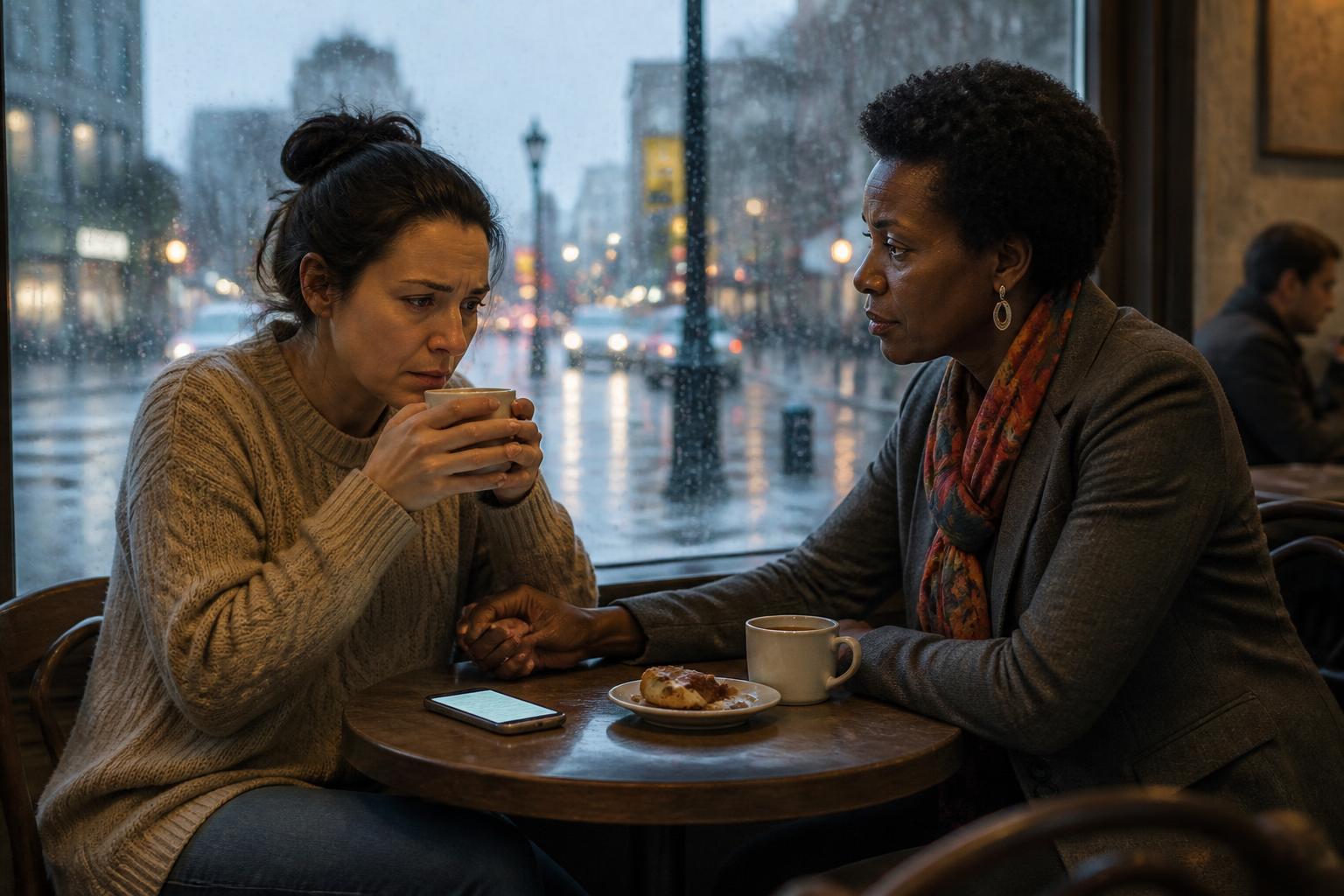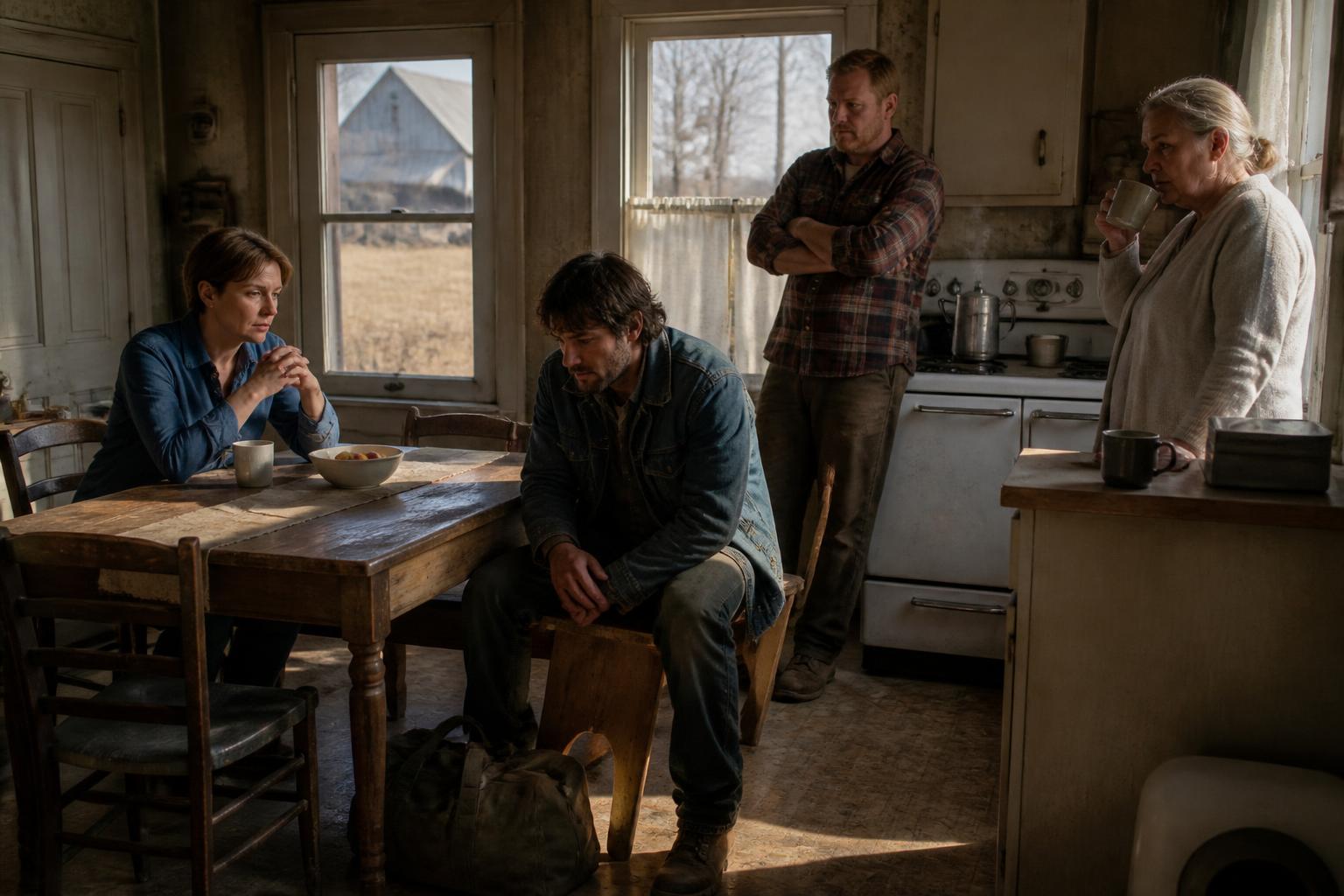







Fiction: This is an original fictional story. Characters and events are invented.
The house already smelled different when Grace and Marcy pulled up, the warm, humid air carrying a faint acridness—smoke and something older, perhaps, tinged with memory. Grace flipped the visor down and stared at the living room window, half-expecting to see their mother’s silhouette, but it was shuttered behind heavy curtains. It still looked like home. Only now, it was a home touched by fire.
Marcy whistled low. “No sign of apocalypse, so that’s a win.” She hoisted a pail of cleaning supplies from the backseat, and Grace snorted despite herself.
“Mom called us at 6 A.M. I was bracing myself for melted siding, not… this.” Grace eyed the wet patch across the porch eaves, some attempted rinsing job from the fire department crews a few hours earlier. “You sure she’s okay?”
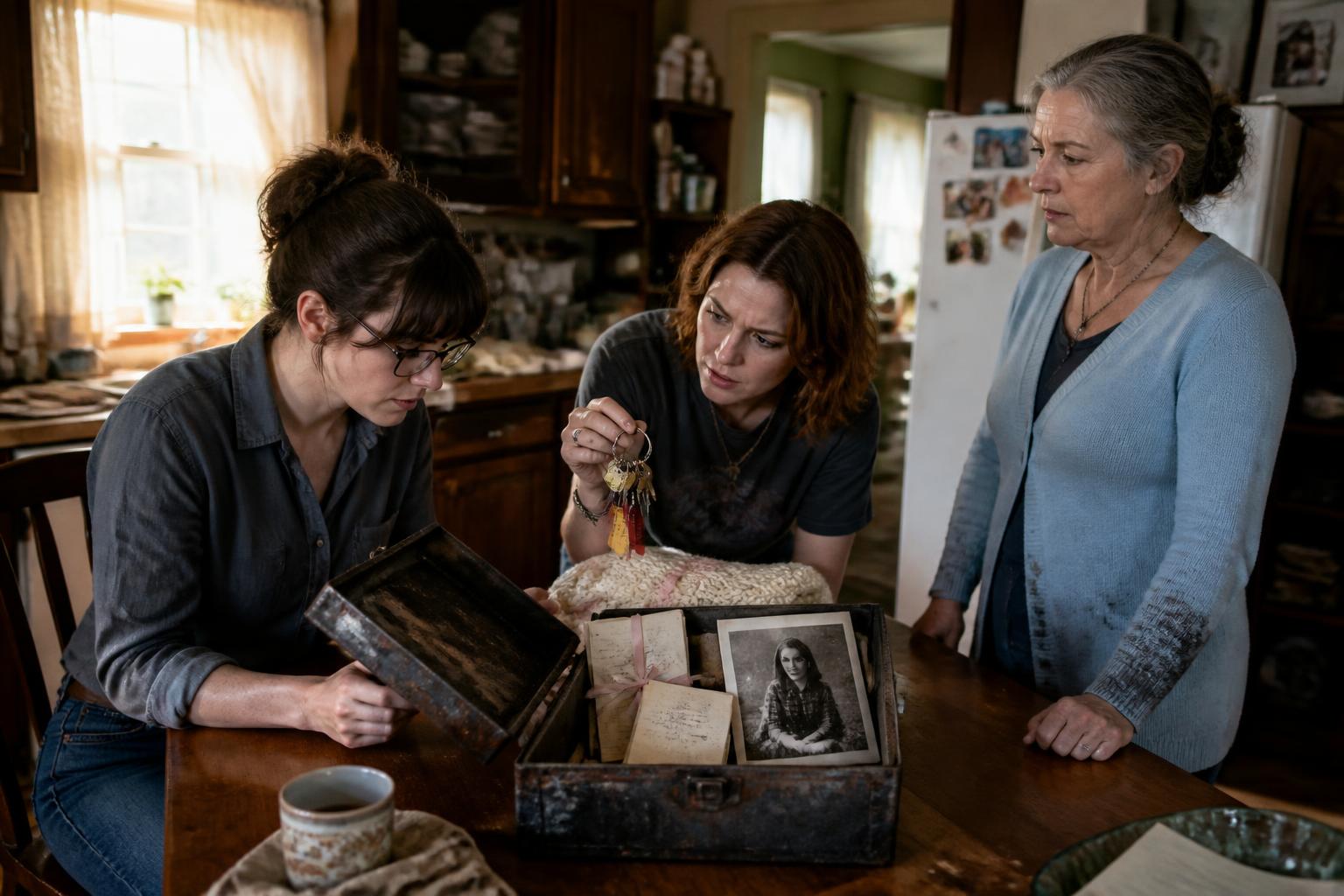
“She fixed coffee. That’s how you know she’s fine,” Marcy replied. Inside, Ellen Abbott moved with practiced precision. She’d always contained herself, her worry pressed back like creases in starched linen. Today, even her cardigan seemed frazzled, pale blue now dotted with soot at the cuffs. She raised an eyebrow when her daughters walked in, lips tightly pressed.
“Smells like a campfire out there, Mom.”
Ellen tried to smile. “Only without the marshmallows, I’m afraid.”
The attic ladder was already unfolded, specks of insulation drifting down like odd snow. Grace slipped off her shoes and climbed after Marcy, each breath dusty, cut by the lingering tang of burned wood. Blackened boxes and picture frames crowded the space. Sunlight angled in through a blistered window, flashing on something metallic nestled beneath a fallen stack of old National Geographics.
As the sisters worked, sorting the barely-touched mementos from the odorous casualties, Grace’s eye kept returning to the fire-scorched strongbox, its handle warped with heat. She nudged it with her foot. The Abbott family wasn’t wealthy; what could possibly be important enough to store up here?
“Hey. Marcy.” She held up the box. The lock clung stubbornly, but Marcy produced a hairpin, and after a few tries (and a little cursing), the lid creaked open. Inside, the past waited: tightly ribboned letters, yellowed at the creases and smoky at the edges; a photograph of a young woman—dark hair, sharp chin, eyes unsmiling—dressed in jeans and a flannel shirt. Neither of them recognized her. Underneath lay a battered ring of keys, each with a color-coded tag, the ink faded.
“Why have I never seen any of this?” Marcy murmured, flipping over one of the letters. “These are addressed to Dad. From… someone named Amber?”
Grace sat back, her mind racing. There was an intimacy to the writing, the looping script and the way the ink sometimes trailed off, as though the writer had hesitated. She reached for the photograph, peering closer. “She’s about Dad’s age, maybe. You think he knew her before Mom?”
“Or during,” Marcy offered, half-joking, but the words hung in the dusty air, heavier than both of them liked. Ellen’s footsteps echoed below; Grace tucked the box under an arm, teeth set.
Back in the kitchen, Ellen scoured the coffee pot, her knuckles white. Grace slid the box onto the table, pushing aside a stack of wet dish towels. “We found this. It was his, wasn’t it?”
Ellen’s eyes flickered between the open strongbox and her daughters. For a moment, her composure wavered. She swiped at her forehead with trembling fingers. “Some things, girls… some things are better left in the past.”
“This isn’t a little thing,” Grace replied, gentle but insistent. “Who is Amber?”
Marcy picked at the keys, fanning them out like tarot cards. “Did Dad—did he have secrets, Mom?”
For the first time since the fire, a real silence settled among them, thick and charged, as if the smoke had drifted down from the attic and found a home at their table. Ellen pulled her cardigan tighter. “Your father was a complicated man. He loved you girls. That’s all that matters.”
Grace looked from her mother to the photograph. Not all secrets, she thought, burn away so easily. She closed the box, feeling old boundaries shifting beneath her feet, and already knew she wouldn’t let this go.
Grace barely slept. The next morning, she left for work early, the scorched strongbox stashed in her trunk. At the museum, her hands moved through the motions of cataloguing 19th-century glassware, but her mind circled back to Amber, the letters, and the mystery keys. During her lunch break, she laid out the clues atop her office desk: one envelope’s postmark was smeared but legible—Pittsford, dated October 1985. She pulled up old directories online, cross-referencing names and places, restlessness leaching into every click.
The photograph haunted her. There was something familiar about the set of the woman’s jaw, something that almost mirrored her own. Grace found herself drifting through the museum’s halls, picturing her father young, living a life entirely separate from the version preserved in family albums. By the time her friend Jorge Romero stopped by her office, she had a legal pad covered in names, dates, and wild speculation.
Jorge peered over her shoulder. “Don’t tell me you’re moonlighting as a detective now.”
Grace offered a wan smile. “You ever seen something like this?” She slid the scorched box toward him, and he examined the lock and tags with the practiced curiosity of someone who’s spent a career opening burned-out doors.
“Fire didn’t reach the inside—lucky break. These keys look old, but see this tag? That’s a standard for garage rentals, the kind landlords use when tenants come and go.”
Something in Grace clicked. “He never mentioned a place outside the house. But… maybe there’s a record.”
“If you want, I can make a few calls,” Jorge offered before adding, quieter, “Don’t let it get under your skin. Some things are locked for a reason.”
But Grace needed answers more than reassurance.
That night, while Marcy was busy wrangling vendors for the bar’s anniversary, Grace dug up property listings and tracked down a rental number linked to the key. The address—an unassuming garage off a dead-end street near the canal—was under Samuel Abbott’s name, monthly payments stopping two years prior.
The next afternoon, Grace convinced Marcy to join her, the promise of a quick detour on the way to the liquor distributor. Marcy grumbled but acquiesced, thumbing texts beneath the glow of her phone as they pulled up to the squat, paint-chipped garage. The lock clicked open with a satisfying thunk.
Inside, musty cold greeted them. Stale boxes lined the back wall. Against a workbench, beneath a tarp, Grace found rock samples in dusty shoeboxes—a dozen pieces of quartz and shale labeled in her father’s tight script. There were stacks of spiral notebooks, their pages filled with field notes, sketches of stratigraphy, and bittersweet entries: “Amber’s favorite spot by the water, 5/87—She laughed when I fell in the mud.” Tucked in one battered box, a pink baby blanket, finely embroidered: “Clara.”
Marcy stared. “What is all this?”
Grace picked up the blanket, fingertips brushing over the name. “Who’s Clara?”
Marcy’s mouth worked, searching for humor and finding none. “Dad never mentioned anyone named Amber. Or Clara. This… it’s like someone else’s life.”
The sisters drove home in tense quiet, the blanket folded carefully on Grace’s knees. Ellen was in the garden, pruning the roses under a slate-gray sky. When Marcy thrust the blanket at her, voice sharp with confusion—”Do you know anything about this?”—their mother’s knuckles whitened around her shears.
“Stop,” Ellen said, her tone clipped. “I won’t do this. Your father’s been gone fourteen years—whatever this is, it should have stayed buried.”
Grace stepped forward, gentle but relentless. “How can we ignore it? Amber’s letters, the blanket… someone—maybe a child—was part of his life. Doesn’t that matter to you?”
Marcy joined in, voice trembling now. “We just want to know what’s true.”
Ellen turned away, shoulders hunched. “You’re looking for trouble. I’m asking you—drop it. Leave it alone.”
The sisters exchanged a glance, helpless in the deepening shadows. For the second time in as many days, the past pressed in around them—unyielding, unresolved.
Late that night, after Marcy had given up and left for the bar’s closing shift, Grace found her mother in the kitchen, standing stock-still in front of the open refrigerator as if the pale light might offer answers the day could not. Ellen shut the door quietly, her face old in the hush, and poured herself a glass of water. For a long moment, she just stared at it in her palm.
“I suppose I can’t keep you from digging,” Ellen said as Grace lingered at the doorway. Her voice was steady, but the lines at her eyes seemed deeper. “Your father was engaged to someone named Amber. A very long time ago. Before I met him.” She took a sip. The silence stretched, punctuated only by the tick of the clock above the stove. “She disappeared. People said she ran off to Boston, others… Well, people liked to talk.”
Grace sat at the table, both relieved and unsettled. “What happened? To her—or to Dad?”
Ellen’s composure flickered, then returned. “No one really knew. She was there, and then she simply wasn’t. It was a bad time for your father. He went looking, they said. He didn’t find her.” Ellen’s voice thinned, edged with something like resentment. “He was broken over it. By the time I met him, he’d locked that part of himself away. We didn’t… discuss Amber.”
Grace hesitated, heart thumping. “But Mom—the blanket. The letters. Clara. Was there a… a child?”
Ellen pressed her lips together. Pain clouded her expression. “Fine. Yes. I heard stories, after. There was talk—Amber was pregnant before she vanished. Then, months later, the church downtown quietly took in a baby left on the steps. That was before we married. I didn’t ask. I was tired of Amber’s name haunting my house.”
Grace sat back, the shape of her childhood shifting in her mind’s eye. Ellen’s tone softened, almost pleading. “People move on, Grace, when given the chance. He loved you girls. He was a good man, whatever ghosts he carried.”
Before Grace could gather herself, the front door rattled—a reminder of life continuing beyond uneasy confessions. Marcy swept in, cheeks flushed from the chill and from bourbon, her gaze sharp as she plunked her purse on the floor. “Family reunion in here? Or just another existential crisis?”
Grace gestured for her to join them, and Marcy slumped into a chair, facing Ellen with all the exhaustion of someone her age plus the weight of new uncertainty.
The next day, the bar’s anniversary party crackled with distraction: laughter, cheap champagne, old friends from their father’s geology club reminiscing at the end of the polished wood counter. Grace drifted through, glass in hand, only half-listening until she caught snippets of conversation: “Sam was loyal—it tore him up, I remember. But the Abbotts always did right by everyone.” The words echoed, gnawing at her. What did it mean—to do right, or to bury wrong?
After the party, the sisters sat at the back steps behind the bar, surrounded by the muffled clatter inside and the hum of city night. Grace recounted what Ellen had admitted, the missing woman, the rumors of a baby, her own sense of vertigo at the implication. Marcy looked away, chewing her nail. “So what—the blanket was for an actual sister? Or…? Did anyone even look for her?”
Back at home later, restless and unsatisfied, Grace poured over her father’s journals. A name caught her attention—entries about Amber’s favorite rock by the water, sketches of her profile, notes of frantic hope and growing despair. And later, one painful scrawl: “I searched the riverbank again, followed every trail. No answer. Just the blanket. I left it for her, in case she came back. Miss her every day.”
Tears welled, unbidden. The entries bore witness—her father had tried to find Amber and, by all signs, loved her. The ghost of that loss still haunted the corners of their family.
Night deepened, lights out except for the kitchen—where Marcy found Grace hunched over the journals, both women changed, both now wide awake to the presence of something unspoken shadowing their family for decades.
“We can’t just… let this fade out,” Marcy whispered.
Grace nodded. “We need the truth, all of it. For Dad, for Ellen, for whoever Clara was—or is.”
The house, old and battered but still theirs, seemed to brace around them. Down the hall, Ellen’s light flicked on, and the weight of what was unsaid creaked through the silence—not done demanding answers yet.
Grace’s days blurred as she dug through county records, scouring public notices and adoption archives that required every ounce of patience she’d honed as a museum registrar. At first, it felt hopeless; Clara’s name was nowhere, only fragments of a case from 1987—”Female infant, left on church steps, healthy, approximate age: days.” Linking that abandoned baby to their father took a leap of faith and sleepless hours comparing timelines, but the blanket, the letters, and Samuel’s anguished journal entries drew the lines together.
Jorge offered to help with the official channels. As fire marshal, he knew someone at the courthouse, and within a week, Grace stood at the kitchen counter, Mary’s phone pressed to her ear, her hand trembling with anticipation. “I think I found her,” she whispered when Marcy padded in, sunlight streaming behind her. Ellen set down her book, slow and wary.
“Her name is Clara Reilly now. She lives in Buffalo. She—she’s a nurse. Adopted by a family from St. Luke’s. She’s alive. She’s… she’s real.” Grace’s voice threatened to crack with the heft of it all.
Marcy slumped into a chair, silent for a long moment. “So. We’ve got a sister.” There was awe in her voice, but caution, too—so many years of myths tangled into family routine. Ellen stared at the table, her eyes glassy.
“What do we even say to her?” Marcy continued, no trace of flippancy now. “Do we just show up? Send a letter? ‘Hey, our dead dad might be your dad, too?’”
Grace looked to Ellen, who sat rigid, one hand over her mouth as she pressed back tears. “I would have taken her in myself, if I’d known for sure,” Ellen said softly, her first words in minutes. “But I was angry. For a long time I thought if I ignored the shadow she cast, I could keep your father’s memory tidy—keep the house safe. That wasn’t fair to any of us.”
They debated for days. Marcy argued for decisive action (“We can’t be the ones who keep Clara ghosted!”); Grace worried about barging into a stranger’s life. Ellen, for once, deferred to her daughters: “If you want to reach out, I’ll help. But write her first—let her choose.”
Together, the three drafted a careful letter, honest but gentle, outlining what they’d found, who they were, and why the thread connecting them mattered. They sent copies of the photograph, one of Samuel’s journal drawings of Clara’s baby blanket, and an invitation—no pressure—to talk. Days passed in a hush of waiting, each of them living by their phones.
The reply came by email—tentative, cautious, yet unmistakably curious. Clara had known she was adopted, but the specifics were cloaked in polite secrecy; her parents were gone now, and she’d often wondered why she was left, who she looked like. “If your father truly loved my mother,” Clara wrote, “then I want to know the whole of it. Maybe I’ve always needed to.”
The Abbotts arranged to meet the following Saturday. On that day, the house was filled with nervous energy. Grace dusted the kitchen, Marcy baked muffins (more burned batches than successful ones), Ellen changed her sweater twice. When the doorbell finally rang, all three seemed to freeze. It was Marcy who went to answer, drawing in a long, steadying breath.
Clara looked nothing like the photo in the box, and everything like family: the same laugh lines as Grace, the same reserve in posture as Ellen. She stepped inside quietly, eyes darting from one woman to the next, searching for footholds. The air was thick with uncertainty until Ellen, suddenly decisive, crossed the room and pulled Clara into a gentle, trembling hug. For a moment, it was just the two of them, forgiving time and, in some silent way, themselves.
The hours that followed were halting but hopeful—stories traded, photos passed around, pieced-together memories clarifying what the records couldn’t say. Clara asked about Samuel, about Amber, about what might have been, and Marcy, teary and bright, joked about inherited stubbornness. They laughed in awkward spurts and fell silent in comfort. Ellen brought out the pink blanket, cradling it like an old wish, and placed it in Clara’s hands.
As evening settled, the house felt changed—not pristine, but brighter, as if light had finally touched every shadow. The fire’s scars lingered upstairs, but downstairs the Abbotts, old and new, circled the kitchen table. Grace caught her mother’s gaze and offered a quiet, grateful smile. Family wasn’t simple, and never had been. But what mattered, she understood now, was how they chose to gather the scattered pieces, again and again—tenderly, together.