



Fiction: This is an original fictional story. Characters and events are invented.
Clouds rolled across the late March sky, casting quick-moving shadows over the tilled brown acres of the Wicker farm. The land, still waiting for spring, bore scars of another long Wisconsin winter—great patches of thawed mud alongside ragged stubble, the pale roots of last season’s corn curling above the earth. Ava Wicker parked her silver Subaru at the end of the gravel drive and turned off the engine. The house, always larger in her childhood memory, loomed pale and slightly shabby at the crest. She lingered a moment, taking in the sun-faded porch, the empty swing swaying in the breeze, and the faintly metallic smell of cold soil.
Behind her, another car approached up the rutted drive, tires kicking up pebbles. Lucas emerged from a battered sedan, dark hair askew and a duffel bag slung across his shoulder. The siblings exchanged wary half-smiles and a brief, awkward hug. Their greeting was weathered by years of distance, salted with a mutual understanding that they’d both come back only because they had to.
Inside, warmth radiated from the kitchen woodstove. Marlene busied herself at the counter, cradling a mug of tea. She wore gray hair in a neat twist and a pale cardigan, eyes cast down at a crossword puzzle as if the children she inherited had always been part of the wallpaper. “You’re early,” she said, without looking up.
“Traffic was light,” Ava replied, glancing at the wall clock. The steady tick, the same since childhood. Only when she stepped farther in did she notice the silence pressing in on every room. No Eli—no barked instructions about muddy boots or reminders to hang your coat up. His absence felt loud, like a door left swinging in a storm.
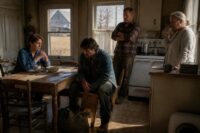
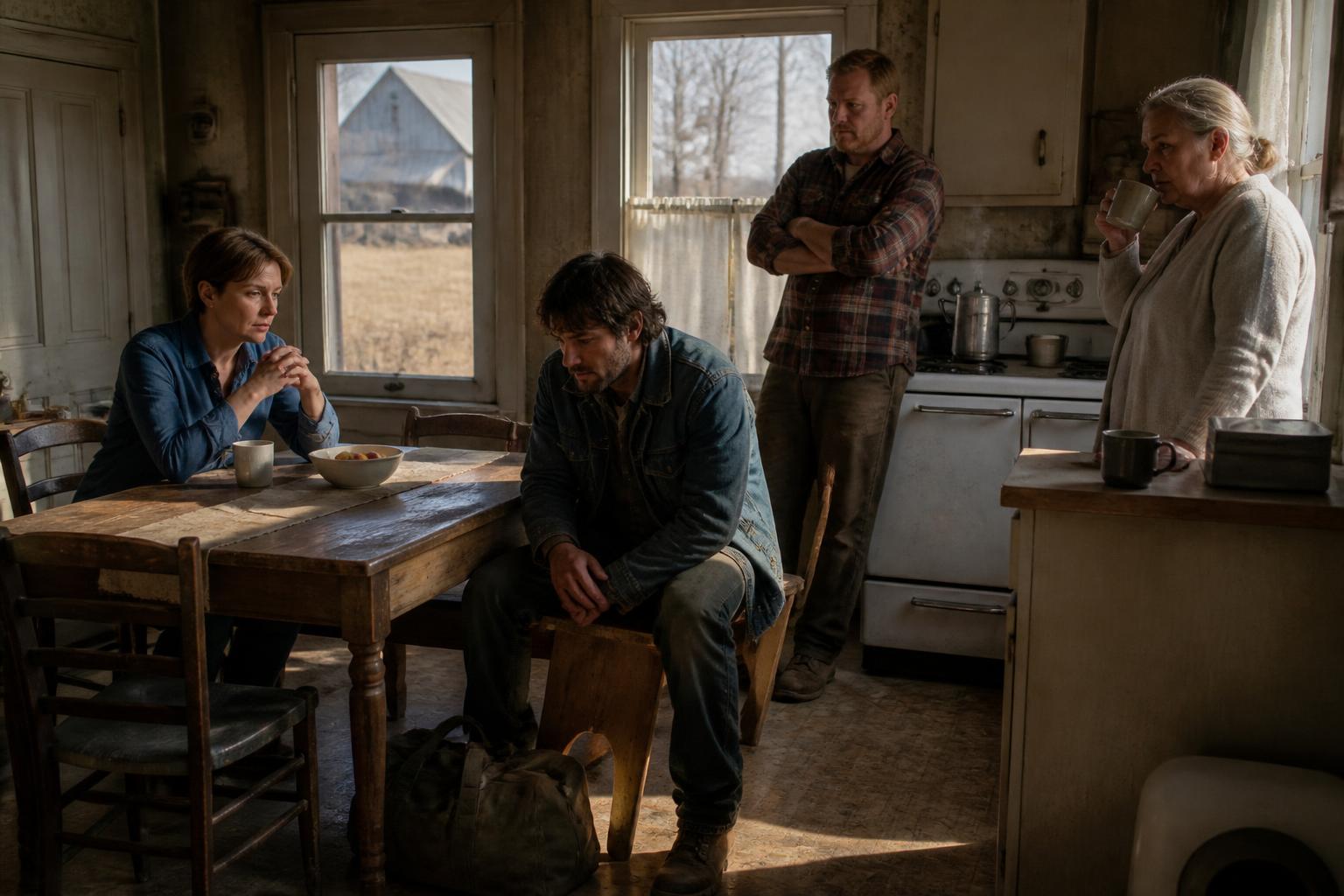
Rory appeared from the mudroom, sleeves rolled, a grease stain dark at his wrist. He stood a little straighter than Ava remembered, brow furrowed, blue eyes unreadable. “You made good time,” he said to both of them. His handshake, callused and brief, offered little warmth. They drifted together in the kitchen, Marlene quietly refilling her mug, Lucas setting his bag down by the bench, Ava pulling up a chair and immediately regretting it.
“Coffee?” Rory asked, gesturing to the chipped percolator, already knowing how Ava would say yes and Lucas would shake his head. Patterns, unchanged. Outside, the late afternoon sun ran over the fields and lingered against the frost-rimmed barn.
They sat without speaking, the farm’s rhythms pulsing through the silence—somewhere, a heifer lowed, a pickup rattled by on County Road W. Memories hovered: summer breakfasts, Eli’s quick bark of laughter, the echo of small feet thumping upstairs. The gaps in the conversation grew until they were as obvious as the empty chair at the head of the table.
“I wish it were under different circumstances,” Ava finally said, her voice too loud. Lucas leaned forward, elbows on his knees; he didn’t meet her eyes. Rory pressed his lips together, saying nothing.
“Your father knew how to make an exit, that’s sure,” Marlene murmured, attempting a smile that flickered away as soon as Lucas didn’t return it. “He left things…prepared. Jane Harrow called this morning; she’ll be here in an hour.”
“The will,” Lucas said flatly, as if checking a box. Ava pressed her hands together. Rory stared at the floor, jaw working. The world outside had shifted, the farm suddenly a stage set with too much history, everyone waiting for the next scene to begin.
“He wanted all of us here,” Ava managed, her throat tight. A thousand Sundays rose up—Eli at the grill, Marlene in the garden, the kids bickering over chores or the last ear of sweet corn. “I guess we finally managed it.”
Footsteps crunched on the porch outside. The siblings stiffened as Jane Harrow appeared in the window, her gray suit sharp against the dull green of Eli’s old screen door. Marlene stood and busied herself collecting half-empty mugs, the air thick with anticipation and something sharper: unease, carefully papered over with family ritual, now threatening to split open as the attorney knocked and, quietly, the past came calling.
Jane Harrow’s entrance scattered the fragile peace like crows from winter stubble. Her briefcase, black and buckled, thudded onto the dining table—a sound that set everyone’s teeth a little more on edge. She offered the briefest of condolences, and a faintly perfunctory smile to Marlene, before working the catches.
“Mr. Wicker left explicit instructions,” Jane said, spreading out a single, cream-colored envelope. “He wanted this read with you all present. If it helps—he was very clear. No room for interpretation.”
She slid the will from its envelope, the paper crisp enough that it seemed to hush the room further. Ava and Lucas pulled chairs in close. Rory remained standing, arms folded, gaze fixed on some fixed point in the distance—past Jane, past his siblings.
Jane began to read. The preamble skipped graciously over legalese and offered a paragraph in Eli’s own words, written in that careful, upright hand Ava recognized from childhood report cards: My children, when you read this, you will know I loved you, each in my own stubborn way. Do not mistake this structure for indifference. I trust you to do what’s right—by each other, by the land.
There were bequests—Eli’s battered guitar to Lucas (“God knows you needed the practice”), a brooch of their mother’s to Ava, the chess set to Rory. Marlene received kind mention, and the keys to Eli’s pickup. Then Jane’s voice gained an edge of gravity as she reached the core:
“I direct that the Wicker homestead, and all its attached acreage, be split equally among my children—Ava, Lucas, and Rory. But only if you, together, reach a unanimous decision within sixty days: sell and divide, or keep and tend. If there is no consensus by the deadline, or a deadlock, ownership is conferred in full to Marlene Wicker.”
For a beat, there was nothing but the tick of the hallway clock and, distantly, the rise of wind against the eaves. Then the reaction—a suppressed gasp from Lucas, a visible tightening of Rory’s fists, Ava’s jaw working before any words found their way out.
“That’s insane,” Ava said, a raw edge in her voice. “He wants us to…what? Hold some kind of family tribunal, with the farm as the prize?”
Rory glared at her. “He trusted us to act like adults, I guess. Or maybe just didn’t want Marlene stuck cleaning up our mess.”
Marlene glanced up—just a flicker of surprise, or hurt, quickly shuttered. “It isn’t about me. It’s his land, his rules. I only ever tried to keep it running.”
Lucas started to speak, faltered, then managed, “Sixty days isn’t much. And… This place needs a lot of work, Ava. You never see it, but—”
“We can’t hang on out of sentiment,” Ava snapped, then caught herself, pushing back from the table. “I know you care, Rory, you more than anyone. But what am I supposed to do, move my whole life back here? You want to, fine. I have a practice, a mortgage—”
Rory looked wounded, but his stubbornness was equally quick to the fore. “You think I don’t get it? But this farm’s all I have. It’s all Dad had left, Ava. Now you want to sell it just because it’s easier on you.”
Lucas’s voice cut across theirs, softer but urgent—”What if we don’t agree? We don’t, so that’s it? Marlene gets everything?”
The attorney cleared her throat. “Technically, yes. But I will require written confirmation of your decision—or lack thereof—before the deadline. It isn’t uncommon, frankly, for families to…struggle with such clauses.”
Ava’s gaze, sharp now, found Lucas. “Where are you on this? Haven’t heard you say. You need cash, or am I wrong?”
Lucas flushed. “Just because I’m not shouting doesn’t mean I don’t care. Look, I’m not set on anything yet. But sixty days to figure out the rest of our lives? That’s a cruel joke.”
The arguments muddled, circling back to open wounds—Ava’s long absence, Lucas’s failed projects, Rory’s insistence that only he understood the land’s worth. Marlene watched in silence, hands folded, eyes shining just for an instant before she composed herself again. Clouds gathered low on the fields as if the sky itself leaned in, listening.
“Dad knew exactly what he was doing,” Rory said, voice thick. “He wanted us forced to pick a side. Well, I pick the farm.”
“And I pick sanity,” Ava replied, quieter now. “But it seems like none of us is ready to make peace—not with him, and not with each other.”
The kitchen, filled with fading sunlight and the dense ache of old, unfinished things, fell back into silence. Jane snapped her briefcase shut, the sound final as a closing door.
The next morning broke brisk and flat, the pale sun barely dusting the kitchen curtains. Ava stood alone at the sink, watching the fields while steam curled from her mug. Rory was already outside—the distant drone of the tractor drifted through the glass, steady and familiar. Upstairs, Lucas shuffled along the hallway, while Marlene’s footsteps came and went in the parlor.
By noon, the house was busy in its own scattered way. Ava found Lucas fixing toast at the stove, slouched and tired. He caught her eye with a half-shrug. “Didn’t sleep,” he admitted, buttering unevenly. “All I dreamt was Dad counting down minutes on his old pocket watch.”
“This thing he left us isn’t fair,” Ava replied, voice hushed. “I can’t even think straight. Every room in this house makes me feel like a guilty kid.”
Lucas eyed her, searching for something in her face. “You really want to sell it? No regrets?”
She didn’t answer. Instead, she moved to the window, arms folded. In the haze above the barn, Rory’s figure cut a sharp line. “He’ll never give in,” she said finally. “You know him. This place is everything.”
Lucas nodded, but his thoughts seemed elsewhere. “I’m stuck, Ava. My lease is up in June. I’m behind—again. I could use my share, even just to breathe. But—” He trailed off, cutting his toast in half. “—I don’t want to be the one who ruins this.”
The words hung between them, unfinished. Half an hour later, Rory stomped in, boots muddy, face flushed from the cold. “The north side’s too wet to till. Feed’s running low. Tractor’s getting temperamental again.”
Marlene paused in the doorway, dishtowel in hand. “Rory, tell them—be honest. They deserve to know what you’re dealing with.”
Rory hesitated, the tip of his boot tracing the linoleum. “We’re behind on payments. I kept it from you both after Dad got sick, but… Property taxes and the machinery loan—there’s not much wiggle room left. If we wanted to keep it—” he met Ava’s eyes, “—we’d have to put in more than sentiment. Money. Sweat. Maybe all our savings.”
The silence this time was different: not angry, but weighted with resignation. Ava leaned against the fridge, pulse rapid. “And if we sell?”
“Split three ways, after the mortgage? It’d be decent. Not life-changing. I checked… last night,” Rory answered, not quite meeting her gaze.
Lucas’s posture sagged further. “Wouldn’t even wipe out all my loans.” He grinned, but there was no humor. “Still. Better than nothing.”
Marlene offered her son-in-law a warm look, but her own worries seeped through every gesture—she wiped the counter with unnecessary intensity, voice low. “There's been offers, off and on. Developers, mostly. Some folks want to turn the back forty into storage units, I heard.”
Lucas’s eyes flashed, nervous and calculating. “Did you keep the names? Numbers?”
“Somewhere in the desk, I suppose.” Marlene’s glance lingered on Lucas, an old suspicion flickering, but she said nothing more.
That evening, as red washed over the barns, Lucas wandered out to the south fence with his phone. He tapped a number from a folded slip, voice low and urgent in the wind. The conversation—brief, halting promises of “just exploring options”—ended with him pocketing the phone as the first stars pricked through the dusk.
Inside, Ava called her business partner in Milwaukee. “I can’t make the numbers work,” she whispered, pacing the upstairs bedroom. “Every dollar’s tied up—student loans, the clinic…I can’t stay. But I can’t walk away, either. Rory, he—he’s holding a thread that keeps coming undone.”
Late that night, searching for an old invoice in Eli’s desk, Ava brushed aside a stack of utility bills. What caught her eye was a recent envelope addressed to Lucas from Bright Edge Development LLC. She picked it up, thumb tracing the bold return address. A jolt of betrayal rose—her brother, already shopping the land behind their backs?
The old house thrummed again with unsaid words. At breakfast, Ava set the letter down between mug and plate. “When were you going to tell us about Bright Edge?” Her voice was quiet but cut through everything. Lucas froze, turning pale under Marlene’s questioning look.
“I only asked for info,” he managed, voice cracking. “I haven’t agreed to anything.” He looked at Rory, who stood without a word, shaking his head, eyes hard as the frozen ground outside.
Whatever truce they’d forged in grief began to splinter. Marlene looked from one to the next, lips pressed thin, as if willing the next words not to fall at all.
After a long silence, Marlene set down her mug and smoothed the front of her cardigan, shoulders drawn small. “Enough. I won’t have this.” Her quiet force somehow brought all three grown children back to the present, riven as it was by their father’s long shadow. “You blame each other,” she continued, voice trembling just barely, “but your father gave you this decision because you are his legacy. Not the land—you.” She paused, lips pressed tight, eyes watering. “He feared you’d repeat mistakes that nearly broke this place apart… years ago.”
Ava hesitated, glancing at Rory and Lucas. “What do you mean?”
Marlene turned to the window, watching the light sift through the pale March afternoon. “He nearly lost it once before, long before I ever came,” Marlene said softly. “Before you were even teenagers. There was a bad year—barn fire, crop blight, money gone missing. He and your mother… everyone threatened to pull away or sell. It nearly did break them. Eli made his will the way he did because losing the land together was the thing that frightened him most.” She tapped her knuckles softly against the countertop. “He wanted to keep you tied to each other, even if it hurt. You were the only legacy that mattered, really.”
Rory dropped down into a chair, elbows on knees, the fight gone out of him. Lucas said nothing, his face drawn. Ava looked at her hands. The memory of their father—the stern affection, the stubborn hope—settled over them like an old quilt. When she lifted her head, her voice was steadier.
“Selling means we lose it all. Not just the land—this, us.” She looked at Lucas, then Rory. “But I can’t run the farm. You know that.”
Rory’s lips thinned, but he managed a nod. “I’ll stay. I’m not scared of work. But it’s too much for one; it always was.”
Lucas cleared his throat. “If we keep it—maybe we don’t have to keep all of it. There are co-ops around town that lease acreage, right? Farm stays, solar. We could lease a patch—make enough to cover expenses, maybe hire help so Rory isn’t buried.” He looked up, uncertain but hopeful. “We don’t have to sell everything.”
Ava considered. Her shoulders softened, some deep tension slipping away. “That’s… not impossible. The town co-op; I saw their flyer at the diner. They’ve got a waiting list. They’d keep it planted, organically, local. It wouldn’t just be another sprawl of prefab houses.”
The idea grew in the quiet, tentative but real. Rory’s eyes met Ava’s with the first glint of hope in days. “You’d be on the deed, but I’d manage. Co-op’s board can help with the business side. We could each chip in a little to catch up the taxes. After that, if things stabilize, maybe the farm pays us back.”
Lucas let out a shaky laugh. “So, nobody gets rich. But at least we don’t lose everything Dad built.” He looked pointedly at Marlene. “You’re okay with this?”
Marlene managed a real smile. “I’ve always been a guest here, but Eli trusted you more than you know. I have a sister in Baraboo who’d love a roommate. I’ll find my own new chapter.”
Outside, the wind picked up, rattling the loose gutter along the porch. Ava stood, hand flat on the sunlit table. “Let’s call Jane. Let’s put it in writing.” She looked around at her brothers—her voice uncertain, but open. “Family vote?”
Lucas nodded, his relief unmistakable. “Aye.” Rory’s answered a soft but certain, “Yes.”
For the first time in weeks, something like peace hovered around the battered kitchen. There was no triumph, just the quiet relief of choosing each other. Rory rose to pour fresh coffee. Lucas brought in more wood. Ava dialed the attorney with a trembling hand and a steady heart.
That afternoon, Marlene began boxing up her papers, leaving the family sign by the lane for Ava to dust off. Rory walked the perimeter fence, boots planted in the thawing mud, feeling—for the first time—not quite so alone against Wisconsin’s capricious spring. The siblings lingered on the porch as dusk fell over the ragged fields, each wrapped in their memories, stitched closer by the strange legacy their father left behind. In the fading light, the farm stood—not as a battleground, but a fragile promise, finally kept.