




Fiction: This is an original fictional story. Characters and events are invented.
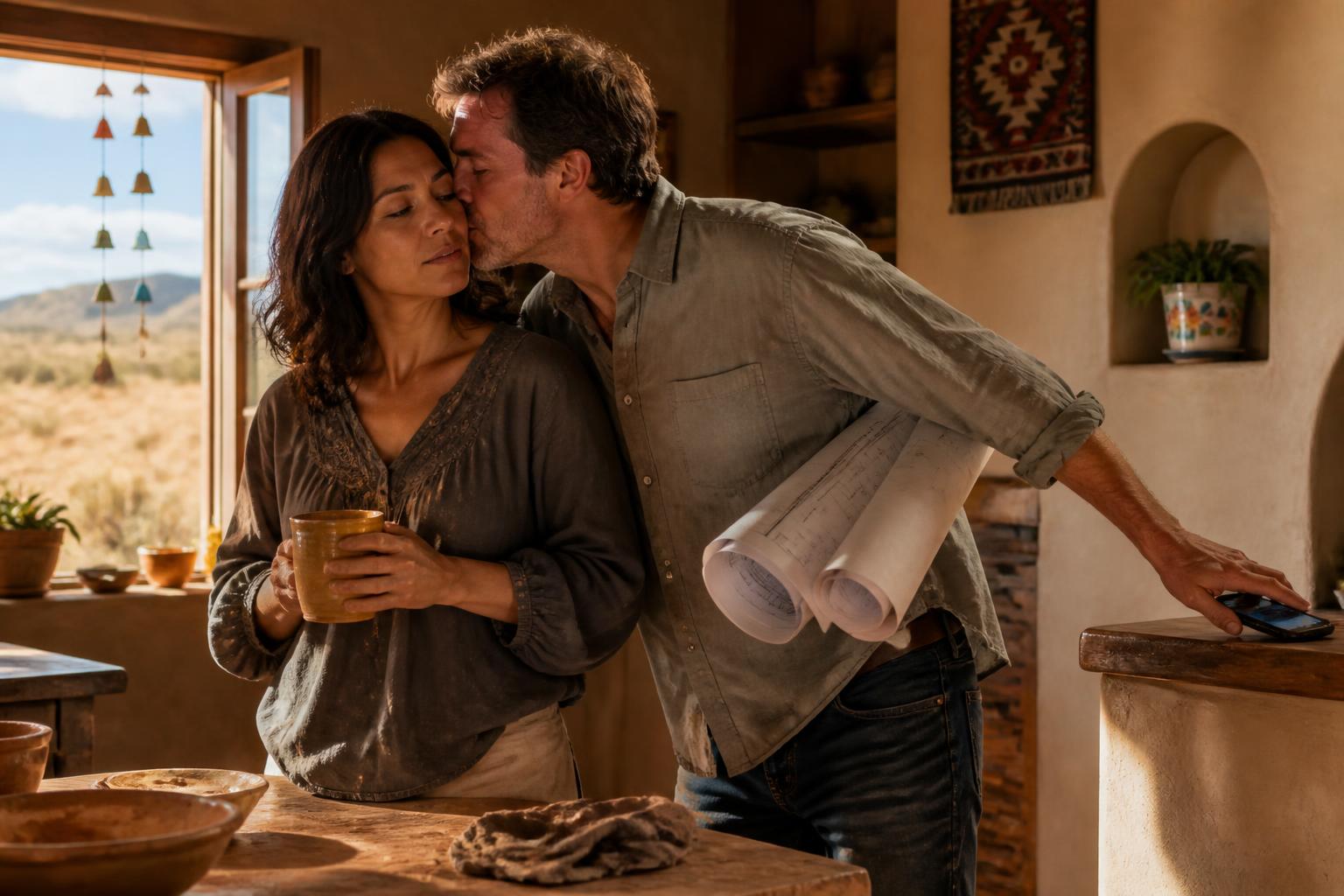
Afternoon sunlight tossed itself in golden patches across the tiles of Clara Mendoza’s kitchen, the adobe walls filtering everything to warmth. She paused, thumb tracing the rim of a mug she’d formed last winter—a contour like riverbed, sealed in ocher glaze. Through the cracked kitchen window, the wind carried the snap of chimes and faraway voices from Canyon Road. Sean’s keys clattered in the entry. He always arrived this way: a storm of energy, design blueprints partly rolled under his arm, hair dusted by the wind.
“Hey, mi amor. I’m home,” he called, already heading past her to the alcove where his phone was buzzing. He gave her a quick, peck-kiss, a routine gesture, but Clara could feel the rush behind it. She watched, brow slightly furrowed, as he thumbed a response to whatever urgent text awaited. He rarely unplugged these days—the Cholla Ridge project, his eco-housing baby, consumed more space in their lives than either would acknowledge out loud.
Sean glanced up, catching her watching. “Sorry. Surveyor’s on site—some issue with the drainage again.” He faced her, lingering long enough to squeeze her shoulder. “How’s the studio this morning?”
“Crowded,” Clara said, half-smiling. “Miguel dropped by just after sunrise, looking for clay. He’s back in town.” The words slipped out casual, but she noted Sean’s brow tighten. For the first time in years, her day had begun with laughter that wasn’t hers alone.
Sean set down his phone. “Miguel Rivera?” His tone managed to sound both polite and careful. “From—what, high school?”
“And every lost summer after,” Clara replied, finding comfort in the old rhythm. “He’s recently divorced. Needed hands in the mud, I think.” She considered adding, He needed a friend. I did too, but let it hang in the space between them.
Sean nodded slowly. “That’s good. A familiar face. I’m glad.” But she could feel him recalibrate, mentally shifting calendars and alliances. He was as guarded as the scattered blueprints in his briefcase.
Later, after Sean left for Cholla Ridge again, Clara slipped into her garage-turned-studio. Afternoon settled soft as talc over her tools—brushes fanned from slip, paper bags of raw desert clay, vases with glazes the color of bruised thunderheads. Miguel arrived, stepping in with the sort of cautious aimlessness of a man trying to reclaim old territory.
“You still keep this place as beautiful and messy as I remember,” he grinned. He rolled up his sleeves, fingers testing the weight of a half-formed bowl on the wheel.
They worked in companionable silence, the whirring wheel and Miguel’s subtle presence siphoning away some of Clara’s recent tension. Miguel told her halting stories about Tucson and Phoenix, lonely stretches of road post-divorce, the comfort of finding New Mexico’s skyline again. Something about his ease coaxed fresh ideas out of her—a different kind of inspiration than she remembered.
At dusk, Clara walked up to Anya Vidal’s gallery—a wedge of modern glass wedged among old stucco, the sign painted in her sharp calligraphy. Inside, the hum was practical: artists coming and going, Anya perched behind her desk. When Clara arrived, Anya’s eyes lit up with genuine warmth.
“It’s been too long, chica. You’ve been hiding.” Anya embraced her, then set about making tea. “Word is out—your new series caught the eyes of the Georgia O’Keeffe folks. I want your work front and center next month.”
Clara’s doubts spilled forth. “I’m not sure the inspiration’s there, Anya. Too much… static at home.” She hesitated before adding, “Sean seems further away every week. I barely see him before bed.”
Anya stirred honey into the tea, expression pensive but careful. “He’s busy, Clara. Everyone’s busy. But—” She paused, forehead wrinkling. “Honestly, he was by here last week. Wanted to talk. About the project, sure, but… also you. He seemed—unsteady. I told you, I'm always here.”
This new worry coiled around Clara’s mind. It wasn’t jealousy, exactly—more the sting of secrets being nursed somewhere out of reach. Yet that night, in the hush after Sean returned late, his apologies smudged with exhaustion, Clara realized she craved the certainty of clay more than words. Only in the cool embrace of the wheel, surrounded by the strength of old friends and her own hands, did something approaching peace find her again.
Morning unfurled, taut and bright, across the plaza the next day. In the soft half-light of her studio, Clara wiped slip from her hands and glanced toward the house. On a whim—a blend of suspicion and self-doubt—she fetched Sean’s phone from where he’d tossed it in a hurry the night before, screen still dark. She hesitated only a second before her thumb swiped it open. The guilt was immediate, hot behind her ribs, but curiosity was stronger.
Inside, texts hung in tidy threads. Clara scrolled through his usual work messages before she saw Anya’s name. The conversation sprawled over weeks, not overtly romantic but more intimate than she’d guessed. Bits flashed at her: This stays between us, okay? and I can’t talk to her about it. And then, Anya’s careful words—She’s stronger than you think. But maybe you need to say things out loud.
Clara tensed, heart thudding. Beneath the surface formality, emotion ebbed and spilled. Sean vented: about the pressure of Cholla Ridge, late-night panic, feeling opaque to Clara. Anya’s responses were soothing but threaded with knowing. Never crossing a boundary she could declare, but—Clara’s jaw locked—it was something neither had confessed. A quiet, necessary wound. She tucked the phone back in place, hands trembling slightly, uncertain whether she felt more angry or ashamed.
Later, she drove the old Corolla through town, past radiant murals and the sudden shadow of a summer cloud. She scanned plaza faces for Anya’s trademark stride but didn’t see her until she reached the side door of the gallery. There, Anya’s sharp profile bent over a shipping manifest.
“We need to talk,” Clara said. She barely recognized her own voice—steady but brittle. The words nearly stuck, as if they didn’t belong between friends.
Anya straightened, guarded. “Clara, what’s wrong?”
Clara hesitated, then let the words tumble in a low rush. “I saw your texts with Sean. I needed to understand.”
Anya’s face paled as she led Clara to her office, closing the heavy door with a deliberate click. She perched on the edge of her faded velvet chair, hands pressed tight in her lap.
“It’s not what you’re thinking,” Anya said quietly. “He’s… He’s been coming here sometimes. After work. Just to unload. Mostly about the project. Sometimes…about being lost. About you both wanting something together, and not knowing how. I’m sorry, Clara—I should’ve told you. I didn’t want—” She winced, shaking her head. “I didn’t want to betray you. But he needed someone impartial. And I let him.”
“I feel like I’m locked out of my own life,” Clara whispered.
Anya’s eyes glistened. “You have every right to be angry. Tumbling into this—he never said anything unfaithful. Just… alone. More alone than I realized. And so was I, in a smaller way. I’m sorry for keeping it in the dark. For both of you.”
Clara’s breath came ragged. She stood, arms crossed against her chest, trying to turn accusation into something less corrosive. “I need some space, Anya. From this, from…everything that feels like it isn’t mine.”
On the walk back, dry desert wind pressed against her skin, sharp as nettles. At the house, she found Miguel leaning against his truck, kicking dust with his boot.
“You okay? You look like you tangled with the wrong cactus,” he said, voice gentle.
She managed a small, grateful smile. “Rough morning.”
He nodded, offering nothing but his hands, rough and open, dusted with clay. Together, they retreated to the studio, letting silence stretch between them—safer than words.
Sean, meanwhile, left work early for once, finding his own house both unfamiliar and echoing. He dialed Miguel’s number, thumb hovering hesitantly. The line clicked, Miguel’s voice level but cautious.
“Hey, man. Got a minute?” Sean’s tone faltered, cracks showing.
Miguel, catching the edge of something heavy, just said, “Yeah. What’s up?”
Sean hesitated. “I screwed up. I don’t know how to talk to her anymore. The project… us. She’s so far away, and I made it worse somehow. You ever have that—so much gets in the way you can’t see the person in front of you?”
Miguel let the silence linger before answering. “You don’t always get to fix things by talking harder, Sean. Sometimes it’s what you do after the words.”
The call hung there, and both men sat with that ache. Santa Fe, endless sky overhead and orange dust at their feet, seemed to press their small confessions into the horizon, where nothing was hidden for long.
The night of the gala bloomed against the cerulean sky, all copper lanterns and sudden swells of laughter out front of the gallery. Clara arrived alone, her favorite indigo scarf drifting behind her like a slow current. She stopped for a breath at the entrance, straightening the lapel of her thrifted jacket, heart thudding not from pride but from the low, foggy urge to vanish into the crowd. Anya met her at the door with the tense smile of someone still hoping wounds might heal if they're layered with enough applause.
Inside, Clara’s vessels lined the central pedestal—bowls that caught the gallery’s light and deep vases resembling cloudbanks, rimmed with desert colors. Strangers murmured appreciation. A critic from Albuquerque scribbled in a notebook. Clara let herself float through their approval, her mind only half-there, the rest drifting toward the ruptures at home. She greeted patrons, accepted congratulations, and managed the smallest smile for Anya, but the rift between them felt sharp as mica shards.
Sean arrived half an hour late, hair still damp from a hasty shower, suit rumpled. He hovered near the displays, greeting people distractedly. Their eyes met across the room—Clara’s steady, Sean’s searching. He crossed over, posture guarded. “Your work looks incredible,” he said, voice too bright. “You should be proud.”
“Thank you,” she replied, tight as wire. The words had lost their meaning. She glanced away, motioning for space. Sean’s hand hovered near her arm but didn’t close the distance; the moment snagged on every unsaid thing between them.
After too many hollow exchanges, Sean found Clara near the back hallway. “Can we talk?”
She nodded—habit, not invitation. They stepped into the utility corridor, fluorescent light striping the tile. The hum of voices became a wall against them.
“I’m lost, Clara,” Sean said quietly. “I thought I was doing the right things—I thought if Cholla Ridge worked, everything else would come back together.” He pressed his knuckles into his forehead. “I’ve been talking to Anya. I know I should’ve said something, but I didn’t know how. You and I used to know how.”
Clara crossed her arms, tears pricking but not falling. “I never asked you to be perfect, Sean. Just not to hide. If you needed someone else to let it all out, you could have told me. But you kept me out. Both of you did.”
Voices rose and fell beyond the utility closet—the world indifferent, celebratory. Sean’s jaw clenched. “I thought protecting you meant not showing you how scared I was. That was wrong. I just… I’m sorry.”
She let out a breath. “I can’t do this here. Not tonight.” She stepped away, brushing past him back into the wavering warmth of the crowd.
Spinning out among well-wishers, Clara only felt relief when Miguel appeared by the sculpture wall, hands in his jacket pockets, easy smile softened by concern. He greeted her with a loose hug, his presence mercifully undemanding. “Need an escape?”
“God, yes.” They slipped outside—into the mild press of night, beyond the blurred windows and trailing applause. Clara exhaled in the cool air, pulse slowing as Miguel leaned against the low adobe wall beside her.
“You want to talk?” he asked, voice low, oracular. “Or just breathe?”
“Talking’s overrated tonight.” She watched the stars blink alive above the city’s dark silhouette, the grid of old roads and new hotels. “Sometimes it’s enough to just not talk.”
He nodded, gaze steady on the horizon, letting silence exist where words only made things fray deeper.
Inside, Anya lingered by the doors, the weight of the past weeks crumpling her composure. Eventually, she slipped outside, heels crunching on the gravel. She found Clara and Miguel bathed in porch-light shadow.
“Clara,” she began, voice ragged. “I know—after tonight, after everything—I’ve got a lot to answer for. I want to fix it, if I can. Or at least listen without defending myself. I hate that I hurt you.”
Clara turned, exhausted but gentler now. “You don’t have to fix it. Just be honest. No more secrets.”
Anya nodded, eyes shining with regret and something like hope. “I can do that.” The wind lifted around them, carrying far-off music and the scent of sage. For a long moment, the three friends let the hush sand down what words could not yet mend.
Meanwhile, Sean lingered inside by the windows, watching Clara step out of the light and into her own orbit. Alone with his reflection, he began to see—for the first time—how much of him was spent waiting for someone else to tether him to himself. That emptiness, he knew, was his own to face.
When the last lanterns flickered out and the plaza emptied, Clara walked home under a vault of stars, the cool air cleansing. Her phone buzzed—a simple message from Sean: Let’s talk soon. Properly. She paused, fingers hovering, then slipped it back into her pocket. For tonight, there was nothing more to say.
Over the next few weeks, the shadows between her and Sean stretched and softened. They stopped pretending. The house quieted, neither tense nor hostile—just honest, stripped of their old choreography. Clara threw herself into hours at the wheel, letting shape and color siphon away grief. She found that inspiration threaded through her loneliness, not in spite of it. Bowls deepened, plates warped into new forms. Her hands, streaked with red clay, learned patience. Miguel kept visiting; sometimes they worked side by side, sometimes they simply sipped weak coffee, swapping silence for steady friendship. There was comfort in a presence that didn’t threaten to become anything but itself.
Clara started seeing a counselor alone, then later she and Sean shared a few joint sessions. Sometimes the air was thick with old ache and unfinished sentences; other times, laughter surfaced—burying the certainty of ending beneath all the good years that led there. Mostly, they listened. One day in April, under the glaring clarity of the high desert sun, Sean suggested they drive out past town, toward the overlook where a decade and a half ago they’d stood, full of hope, mapping out their life in paint and clay and blueprints.
The hillside was quiet except for the wind and a pair of ravens circling above the cottonwoods. Clara’s palms were dry as she traced the tan stone wall where young lovers’ names pressed through dust. Sean parked, both hands on the wheel. Their silence tasted different now: less defensive, more inevitable.
“We were just kids here,” Sean said softly, eyes trained on the thin blue line of mountains. “I wanted to build everything for us. I thought if I could just design the life around you, we’d be okay.”
Clara inhaled. “I kept trying to hold it together, to not be the one who let go. But I’m different now. So are you. We’re better apart, Sean. This doesn’t have to be a failure.”
He managed a slow, honest smile. “We gave it our best, didn’t we?”
“We did,” she said. “And now we let each other go, so neither of us has to hide anymore.” Tears slid down her cheek—relief and regret braided together—but she didn’t look away.
As they hugged goodbye, all the raw gratitude and tired affection between them pressed close. No drama, no final tearing wound—just a quiet consensus. When they drove back into Santa Fe, separate cars, the city’s adobe shimmered with possibility instead of loss.
Moving out was less traumatic than Clara feared. She found a bright casita overlooking the Sangre de Cristos, sunlight pouring onto a patio big enough for a dozen muddy hands or an impromptu gathering. Miguel helped haul boxes, always careful not to overstep, his humor a balm. Anya showed up with fresh-baked empanadas and a box of new brush sets. She cried as she apologized—really apologized—promising honesty that didn’t blink away discomfort. The three friends dined at the old wooden table, laughter returning in tentative stretches.
Weeks slipped by with long walks along the acequias, afternoons spent teaching local kids to coil pueblo shapes in clay. Clara’s art shed the stiffness of obligation. Collectors called, galleries inquired—but she cared less about impressing and more about creation itself. Sean stopped by one afternoon, bringing a tangle of blueprints to show a house he’d finished for a single mother nearby. They sat with tea, no awkwardness, each changed by gentleness and the absence of old wants.
Spring cracked the desert wide open, green shoots threading through the dry fields. On a dusky Sunday, Clara found herself alone in her studio. The potter’s wheel spun steady. She pressed a wedge of clay into a new bowl, palms guiding its slow rise. Through the open window, thunderheads marbled the sky, but inside, everything was still. Every crease on her hands, every second of chosen solitude, spoke of life returned to her—unvarnished, earned, and enough.