






Fiction: This is an original fictional story. Characters and events are invented.
Lauren Whitaker tossed her travel mug into the dishwasher and glanced out the kitchen window. The morning was soft and gray, Portland’s signature mist curling above their backyard, blurring the fence and mossy stones. She could hear Ethan upstairs, humming as he showered, and for a fleeting second she was transported to a younger version of their lives—his baritone voice echoing off an apartment’s chipped tiles, the two of them scrambling to make rent, laughing over burnt toast. Now the laughter felt thinner, like it belonged to someone else.
Ten years. In less than three weeks, the dinner out, the thoughtful gift, the obligatory card would be exchanged. She should feel something more, shouldn’t she?
She refilled her coffee and set up her laptop at the dining table, textbooks stacked nearby, red pens scattered like confetti. Adjunct work at Hawthorne Community College had felt like the first step on a meaningful path once; now it was grading endless freshman essays that blurred together between walks with Ethan’s golden retriever and late-night, half-hearted attempts at her novel. The cursor blinked accusingly.
Her phone lit up: Monica. She smiled, propping the phone on speaker.
“You up for a café run later? It’s my day off and I need to see someone who knows how much caffeine I require to be functional.” Monica’s voice was brisk, always overlaying an edge of concern.
“Only if we can complain about the utter lack of narrative discipline in Gen Z,” Lauren joked. “And maybe life in general?”
“Oh honey,” Monica said. “You first.”
Lauren hesitated, organizing her thoughts as she watched Ethan emerge from the hallway, hair neatly combed, half-smiling at her before rummaging through a pile of business envelopes.
“I’ll text you,” Lauren finally said quietly, glancing over at Ethan. When the call ended, she slid her computer open, but words wouldn’t come. She watched her husband’s movements: the way he tracked his phone, replied to texts with a private smile. He used to laugh with her in the mornings, make elaborate breakfasts on Sundays, pretend every day was their last chance to celebrate. Now he was out the door before eight most days, home after dark, sometimes with fast food, sometimes already eaten. “Market’s wild,” he’d say, or, “Tom wants to brainstorm over drinks,” and she nodded, telling herself this was how normal marriages aged.
Lauren turned her attention to her phone again, this time tapping out a message to Monica: “I think Ethan’s distracted lately. Like, not just the usual real estate hustle. He’s… somewhere else, even when he’s here.” The reply came in seconds. “Want my honest take-in-person. Let’s meet at Small Batch before noon?” Lauren texted back an affirmative. She heard Ethan’s footsteps pause in the doorway.
“Got a big day?” he asked, zipping his jacket while glancing at his phone.
“Just some grading. Meeting Monica for coffee. You?”
He barely looked up. “Client wants to see a place out by Beaverton. Probably late again, don’t wait up.” He hesitated, then leaned over, brushing her cheek with a distracted kiss. She watched him go, keys jangling, his stride purposeful—the same way he’d walked when they’d been young and breaking rules.
Instead of opening another essay, Lauren stared at her blank Scrivener document. She thought about the last time she and Ethan had spent a whole day together without agenda: a drizzly Saturday hiking Forest Park, trading stories and sandwich halves. That had been before his business took off, before her classes became so rote she could grade while half-asleep, before they’d stopped touching each other with intention.
There were more changes than she’d admitted, even to Monica. The pile of unread books she’d once devoured. The untouched manuscript folder. The dinners eaten in front of separate screens. The way she checked his location on her phone and told herself she was just keeping track, not keeping tabs.
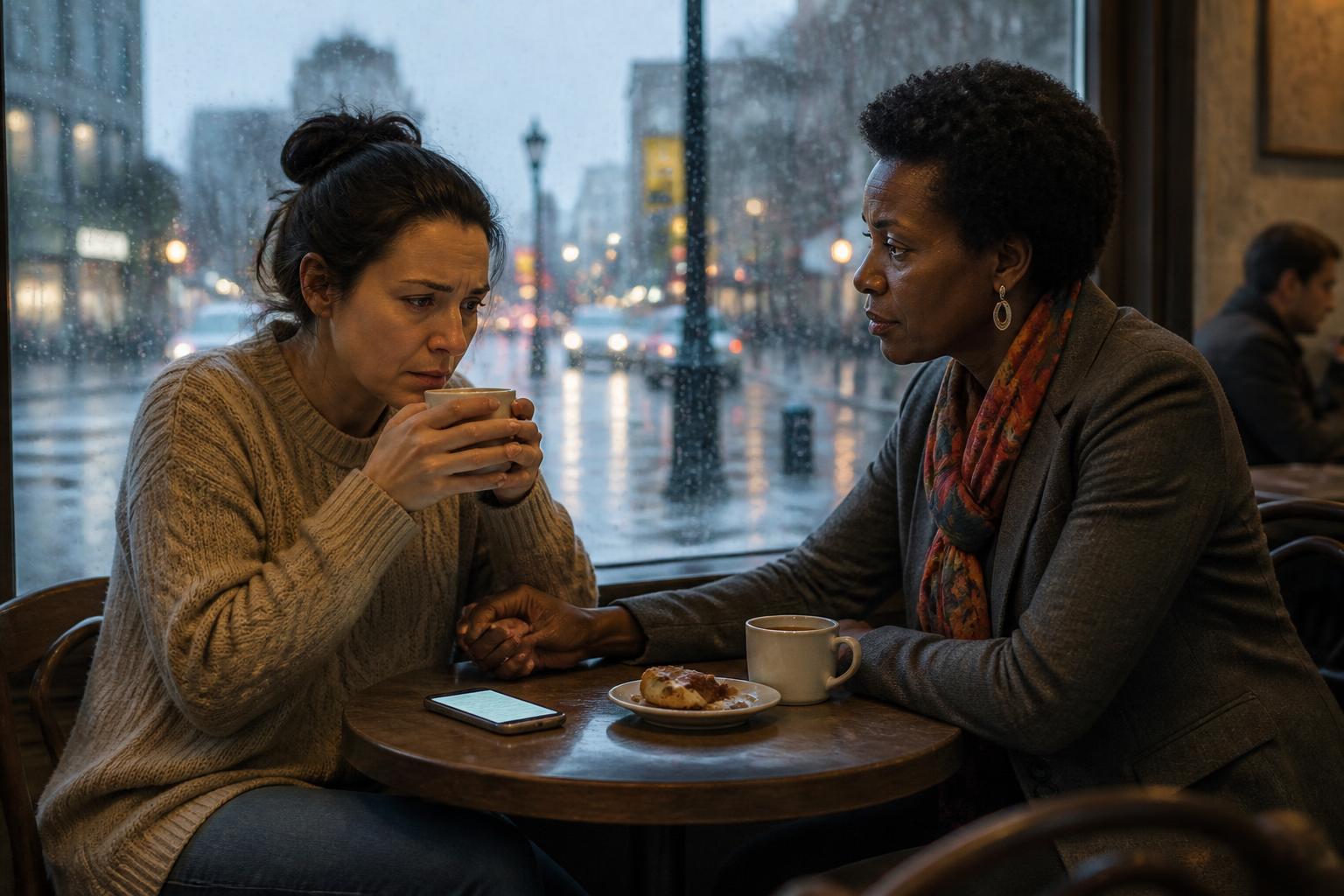
The morning blurred past. Lauren bundled against the drizzle, crossing slick pavement to the café. It was crowded with laptop screens and barista steam, but Monica commandeered a table by the window. They hugged, Monica squeezing extra tight.
They ordered lattes and pastries. Monica eyed her friend. “You look tired.”
“I feel…” Lauren searched for a word, failed. “Stuck. At work. At home with Ethan. Like everything’s just—plateaued. Worse, maybe.”
Monica sipped her coffee. “Talk to me. Really talk this time.”
Outside, the sky was trying to clear. Lauren pressed her palms to the warmth of the mug. “Sometimes I feel like we’re actors in a play. I miss when things felt real.”
Monica watched her, concern cutting through her usual confidence. “Actors in a play means you’re following a script. What would happen if you threw it out?”
Before Lauren could answer, her phone buzzed against the table. Reflexively, she glanced down—Ethan’s name with a preview of a message. Not for her, though. The tiny drop-down showed a fragment of an earlier text, one she hadn’t seen before: “Thanks for last night. Can’t stop thinking about you.”
Her hand trembled. She unlocked the phone, guilt crackling under her skin, and found the text in Ethan’s messages. The sender was labeled only as “R.” Lauren stared, heart throbbing. She hesitated before clicking into the conversation, only to find everything else deleted. Just the one message, standing alone like a flare.
“Everything okay?” Monica’s tone sharpened.
Lauren pushed the phone toward her. Monica read quickly, then looked up, face unreadable. “You need to ask him.”
Lauren nodded, but nausea coiled inside her. “He always says it’s clients. People buying houses, wanting hand-holding. I know he gets weird texts sometimes, but… this doesn’t sound like a client.”
They sat in charged silence, rain spattering the windows. Monica reached across, covering Lauren’s hand. “You don’t know what it means—not really. But don’t let it fester. Have the hard conversation. Secrets rot things out from the inside.”
Lauren’s chest ached. “I just… I want to be wrong.”
After the café, she drifted through the afternoon in a fog. She answered monotone emails from students, ran a load of laundry, reread the message twice more. By the time Ethan got home, darkness had fallen and the house hummed with the dryer’s uneven whine. She watched him carefully as he came in—hair damp, cheeks flushed from the cold, arms full of takeout. He smiled a little too brightly.
“Hey, got Thai. You want dinner first or—” he started, but Lauren cut him off, her heart racing.
“Ethan, can I ask you something?”
He paused, setting the steaming bag carefully on the counter. “Of course.”
She let the silence stretch, every muscle tensed. Finally: “Who’s ‘R’? You got a text. It didn’t… it didn’t sound like business.”
For one second, time held its breath. Then: “Oh—God.” He rubbed his eyes. “Rachel. She’s a client. Going through a mess of a divorce, really needy. Sometimes the lines blur, but I promise it’s nothing like you’re imagining.”
“She said thanks for last night,” Lauren whispered. “Ethan, just be honest.”
He looked away, jaw twitching. “It wasn’t what you think. She—the deal almost fell through, she called late. I took her to coffee, talked her down from a panic attack. I didn’t want to dump all this on you when you hate my work drama.”
Lauren wanted to believe him. But she heard the practiced tone, the salesman’s slide into plausible half-truths. Still, she nodded—or maybe just pretended to.
“Okay,” she said flatly. “I just… I’d rather hear the truth than feel crazy.”
He exhaled, setting out takeout boxes in silence. The meal passed in polite fragments. Ethan checked his phone compulsively; Lauren pushed pad thai around her plate, finding herself scrutinizing every gesture. They watched an episode of a series and barely laughed. When Ethan kissed her goodnight, Lauren barely felt his lips at all.
Later, in bed, Lauren opened her novel draft for the first time in weeks. This time her protagonist’s marriage was a study in shadowboxing: words said and unsaid, secrets pressing at the edges. The sentences spilled raw, shaped by her mounting suspicion. Betrayal pulsed through every chapter. She wrote until her fingers cramped, until dawn threatened behind the curtained window and Ethan slept heavy beside her, a world away even in their shared bed.
Across town, Ethan’s car idled outside a row of new townhouses. Tom clambered in, shaking rain from his jacket. Ethan gripped the steering wheel, eyes shadowed.
“Rough week?” Tom asked. “Or just more late nights closing?”
Ethan hesitated, then shrugged. “Lauren and I… we’re off. I don’t know. Feels like I can’t say anything right lately.” He caught Tom’s look and smiled thinly. “Don’t worry, it’s not as bad as your divorce.”
“Famous last words,” Tom muttered. “You doing okay?”
“Yeah,” Ethan lied. “Just tired. Everyone wants too much.” The rain drummed harder, drowning out further conversation. Behind his composed smile, Ethan felt the same weariness Lauren carried—a dull ache where easy connection used to live.
The next morning brought its own cold clarity. Lauren moved stiffly through her routines, every sound—Ethan’s footsteps on the hardwood, the whir of the coffee grinder—suddenly sharp. He moved around her with extra caution, as if her grief was visible, something to be dodged. When he reached for the cereal, their hands almost touched. Almost. Just before he left, he paused in the foyer, his gaze restless, fingers drumming against the doorknob.
“We have to talk,” Lauren said, her voice careful and stripped of accusation.
Ethan’s shoulders dropped. “Yeah. I know.” He set his briefcase down. For once, he didn’t reach for his phone. “I’ll be back by seven. Let’s really talk then, okay?”
The hours crawled. Lauren stared at her bare manuscript, scrapped half a paragraph, then surrendered. She called Monica. Monica answered on the first ring, her tone brisk until she heard Lauren’s small, hollow hello.
“You talked to him?” Monica asked.
“We skirted it but… tonight. I don’t know what I’m supposed to feel, Mon. Angry, jealous, stupid—he keeps insisting I’m seeing ghosts.”
Silence on the line, then Monica sighed. “Most people get lost sometimes, Laur. Even the good ones. Doesn’t mean what he did isn’t wrong. But all those late nights, the way you’ve pulled away into schoolwork, writing—do you think maybe he felt lonely and just didn’t say?”
Lauren almost snapped back, defensive. Then she thought about all the blank looks they’d exchanged, the meals eaten in silence, the gulf between her need for reassurance and her refusal to admit it.
“Maybe I did check out,” Lauren whispered. “But so did he. I miss feeling wanted, Mon.”
Monica exhaled. “Ask for what you want. Be honest, even if it hurts. You write these fierce women—try being one for yourself.”
Lauren hung up feeling raw, uncertainty an ache at her core. She made it through her day—graded a stack of papers, lectured on narrative conflict—but everything felt hypothetical, like acting in someone else’s life. Each time her phone chimed, her stomach clenched.
Ethan was home by dusk, face drawn and hair slightly mussed. He closed the door softly behind him, but the click echoed anyway. They faced each other across the kitchen island, the unspoken words swelling between them.
“I read the text again,” Lauren began, voice trembling. “I don’t want to be the kind of wife who snoops. But I feel crazy in my own house.”
Ethan rubbed his hands together, words coming out halting. “Lauren, I’m sorry. I should’ve told you everything. Rachel—she’s going through hell. I was flattered, I guess. She… liked needing me.” He stared at the cutting board, unable to meet her eyes. “Nothing physical happened. Not even close. But maybe I wasn’t as careful with her feelings as I should’ve been.”
The admission stung worse than a lie. “So it was emotional,” Lauren said quietly. “You told her things you wouldn’t tell me?”
He nodded, shame flushing his cheeks. “I felt invisible here sometimes. I’d come home and you’d already be asleep, or buried in grading, or just… somewhere else. I know I should’ve fought harder. I was tired, Laur. It felt good to have someone look at me like I mattered.”
Lauren’s throat tightened. “You could have told me you felt like that, Ethan. Instead you—” She broke off, hands pressed to her eyes. “All these years, and we handle this like amateurs.”
The silence wore on, heavy as Portland rain. Finally, Ethan crossed the room, hovering just out of reach. “I swear, Laur—nothing happened. I wanted to tell you. I didn’t want to lose what we had, even when I already felt like we’d misplaced it somewhere.” His voice broke, and in that moment Lauren saw not the polished realtor but the man she’d met a decade before, lost and hopeful all at once.
They stood together in the kitchen, surrounded by uneaten leftovers and unpaid bills. Guilt intersected with longing, cutting through the numbness. Lauren wanted to reach for him—and also to throw a glass across the room and see it shatter.
In that trembling, airless moment, neither apology nor anger could fill the space between them. They both stood small and exposed, uncertain how to find their way back—or whether they could.
Neither said another word that night, but when Lauren sat in the quiet of their dark living room, she made the decision: they couldn’t sweep this truth under the rug, not after so many unspoken resentments. She listened to Ethan’s restless movements from the bedroom as she pulled up a list of counselors on her phone. Tomorrow, she would ask him to try—or at least, to try something. For all the shabbiness between them, she didn’t want to give up on the life they had built together without knowing they’d tried everything, no matter how long and painful the road ahead.
The next week unfolded hesitantly, like a new draft written in pencil: smudges and erasures as Lauren and Ethan skirted around their routines, neither quite ready for ordinary affection, both a little softer in the spaces where their anger used to flare. They scheduled an appointment with Dr. Choi, a couples therapist across town who offered evening hours. Lauren wasn’t sure if she wanted healing, revenge, or release—only that she wanted clarity.
Their first session was painful in a way that felt necessary. Lauren spoke aloud the grief she’d been swallowing for years: her exhaustion, her sense that she was always holding her breath, her anger at Ethan but also at herself. Ethan admitted how small he’d been feeling, how much he’d missed their old closeness, how he had almost told Rachel things he should have told Lauren. Dr. Choi nodded, drawing long timelines and softer questions until, exhausted, both Lauren and Ethan could see the silhouettes of their own disappointments etched against each other. Afterward, walking to the car in the misty evening, Lauren didn’t know if she felt better, but she felt something break loose inside—a stone giving way under years of sediment.
Meanwhile, Monica’s voice grew steadier in Lauren’s life, the texts and calls turning from crisis to companionable silence. Monica had started having lunch with Tom—first out of solidarity, then out of honest curiosity. Tom was still raw from his own divorce but less brittle each week. When Lauren met Monica at Small Batch the following Friday, she found them at their usual window table, laughter spilling between scones and stories. Lauren felt a glimmer of relief: heartbreak didn’t always mean an ending; sometimes it was an introduction.
Nights, Lauren found herself writing again. This time, her characters’ voices felt messier, less certain. She stopped trying to fix her fictional marriage. She let her protagonist unspool all her longing and rage, her capacity for forgiveness, her fear of walking away and her hope for choosing something different. Lauren wrote late into the night, sometimes in the living room while Ethan read quietly across from her—separate but not hostile, tentative as deer in a clearing. She let the words flow, not caring if they were publishable, just needing them to exist.
The anniversary came. They didn’t go out; instead, Lauren made a simple dinner, and Ethan showed up with a small bouquet and an awkward smile. They sat at the table, the air charged, and finally Ethan said, “I want to try. Not because I think we’ll get back to what we were, but because I want to see what we could be—if we’re honest.” Lauren smiled, not trusting language but grateful for his admission.
They kept seeing Dr. Choi. Some weeks, things got worse before they got better—their arguments sharper, more honest. They named the days when love felt easy and the ones when all they could offer was civility and effort. Lauren kept writing. Ethan learned to listen when she read him the difficult scenes, his hand steady on hers, sometimes teary, sometimes silent.
Summer edged into fall. Monica and Tom were officially dating. Lauren submitted a chapter of her novel to a small magazine. Ethan changed the password on his phone, but instead of secrecy it was part of an agreement—they would trust and not chase ghosts. They knew every day was a choice: to forgive, to be honest, to ask for—and risk—not getting what they wanted.
On a cold Saturday morning, Lauren stepped out into the backyard, breath clouding in the gray air. She could see Ethan through the window, making coffee, humming tunelessly. She didn’t know what would happen: if their marriage would become something lasting or something lovingly concluded. But she knew she hadn’t vanished, and neither had he. Here, in the uncertain future, alone and together, somehow both of them were still growing.