


Fiction: This is an original fictional story. Characters and events are invented.
Beth Russo woke to the gentle insistence of her phone alarm and the distant sound of the garbage truck threshing down the block. Her bones ached in the half-dark bedroom, a nagging echo of thirty-eight years stitched with late nights, carpool duty, and the slow throb of regret. She rose, careful not to wake Sam in the next room, and padded to the kitchen, barefoot on cracked tile, to start the coffee.
Out the window, St. Charles was already stirring: mail carriers wheeling bikes, a jogger’s breath clouding the morning air, the muddy green of the river just visible between budding branches. She opened her laptop at the kitchen table, ready to scan overdue book notices and field texts from the head librarian about a printer crisis or an upcoming poetry night. Instead, her focus was drawn to a flyer, crumpled and soulful in Sam’s tidy handwriting, stuck to the fridge with a magnet from a local barbecue place.
“Run for a Cause! Charity Relay—Family Teams Welcome!” it read, in printed blue below blocky clip art sneakers.
Beth sighed, recalling her promise—only half meant—to do something active with Sam this spring. He’d been quieter than usual lately, retreating even further into books and sketchpads, his thoughtful face tart with longing and uncertainty. She’d chalked it up to adolescence, the looming shadow of high school drama, the inevitable orbit around her awkward divorce from his father.
When he appeared in the kitchen, already dressed in running shorts and an old chess camp T-shirt, Beth blinked. “You’re up early.”
“Race entries close today.” Sam stood by the sink, uncertain. “I put our names down—hope that's okay.”
She wanted to protest—to point out she hadn’t run a single mile since 2018, or that she had bunions—but Sam’s hopeful glance silenced every excuse. Beth smiled instead, aiming for bravado. “Guess we’d better start training, then.”
Later that afternoon, Beth and Sam arrived at the riverfront trailhead, sun-dappled and busy with runners. The March air still bit through her leggings, but a crowd had gathered around a folding table strung with homemade banners. Volunteers handed out sign-up packets and bright mesh vests.
As Beth fussed with the paperwork, she glanced up at the sound of laughter—a sharp, familiar note. Memories, sharp and unwelcome, tumbled back: high school bonfires, secrets whispered behind hands, the bright burn of old betrayals. Kevin Braddock, lean and tousle-haired even under a ball cap, was joking with a red-haired boy at a nearby table. He caught Beth’s gaze, blinked, and, after a moment, tipped his head in a tentative salute.
Beth’s chest seized. She hadn’t spoken more than a passing word to Kevin in over a decade—not since shared confidences ran aground on pride and she’d walked away. Their friendship, once effortless, had shattered under the weight of hurtful confessions passed to wrong ears, anger flaring and cooling but never extinguished.
As she fought the urge to slip away, someone tapped her shoulder: April Drew, with her brown hair scraped back, EMT vest hanging loose over scrubs. Her smile was tight, betraying sleepless nights and something older—a fatigue that went beyond her shift. “Beth! Can you believe they roped me into first aid duty?” April’s voice strained for cheer. Behind the humor, Beth caught a flicker of bleakness. April’s eyes darted to Kevin and back.
“I guess none of us really left, did we?” April added quietly.
The crowd thickened, an organizer’s bullhorn crackling. Sam shouldered his gear and flashed Beth an uncertain smile—a flash of the little boy he’d been, bracing for embarrassment and hoping for glory. Beth’s nerves jangled, a chorus from the past. Was she really ready for all of this—the race, the reunions, the risk of reopening old wounds?
She glanced at Sam, at April, at Kevin across the milling crowd. The river rolled on beneath the morning, indifferent to fractured friendships and relit hopes. Beth took a breath, feeling the weight and possibility of the day press in. “It's just a race,” she told herself, unconvincingly, as the starter called teams to order and the memories crept closer, ready or not.
Training for the relay became a ritual. Each gray-lit morning and a couple evenings after work, Beth laced up old sneakers and jogged with Sam along the river path, her joints stiff, lungs straining past the memory of easier years. Sam didn’t complain; he matched her pace with quiet patience, sometimes pausing to sketch the cranes by the water or point out the budding sycamores. She admired the gentle way he accepted her, flaws and all—a currency rarer than victory laps.
It wasn’t long until their preparation put her in Kevin Braddock’s orbit. She spotted him ahead one evening, pausing to tighten his shoelaces near the war memorial, his laugh carrying as he walked beside his young teammate. Beth hesitated at the edge of the path, heart thudding—not from exertion. Inevitably, paths crossed. Kevin’s face set when he saw her, careful and wary, but he stopped, nodding politely.
They exchanged greetings laced with too much history. Sam, uneasy around adults anyway, looked sidelong between them. Kevin knelt to tie a shoe, then stood, meeting Beth’s gaze. “Looks like the old crowd’s out in force for charity, huh?”
“Guess St. Charles can’t resist a good cause,” Beth replied, tone brisker than she meant.
Kevin nudged gravel with his running shoe. “Funny how some things never change. I still get stuck with the slowest partner at the last minute.” The words had an edge, masked in humor but sharp enough to sting. Beth almost retorted, but caught herself. Wasn’t this why they’d drifted apart—quips that cut too close, the impulse to win even old, bruised arguments?
“Maybe your training style scared off the fast runners,” she said, attempting levity, but the banter landed flat. Kevin’s smile wilted, uncertain, and with a shrug, he moved on. Beth watched his back recede, feeling unexpectedly deflated.
That night, Beth found herself dialing April’s number. She meant to ask about first aid kits or race logistics, but as April’s voice crackled through the line, Beth’s carefully held worries tumbled out—about Sam, about the relay, about how friendships unraveled so quickly and then stuck in the mind like a torn stitch.
April listened, exhaustion tinging her responses but warmth still flickering underneath. “It’s not easy, you know? I see people—patients, families—so sure life’ll keep going the way it always has. Then something changes. Suddenly they're looking for someone to blame, or someone to pull them through. I think about it a lot, Beth. About quitting. Doing…anything else.” Her voice caught, then steadied. “Sorry. Guess I’m not great company these days.”
“You’re better than you know,” Beth said quietly.
They talked, halting and then in a rush, memories rising—nights spent sneaking out for pie at the 24-hour diner, wild laughter, the shards of things left unsaid after the falling out. April didn’t mention Kevin by name, but Beth caught the hesitation in her questions, the careful circling around old wounds.
On the next training run, Beth caught up to April at the riverside pavilion, where April was restocking the first-aid station. Beth leaned on the metal railing, catching her breath. “What are we doing, April? I mean, how did it get like this?”
April’s eyes softened. “Probably the same way it always does. Life happened. Secrets, mistakes. I wish I’d called you back then.”
Beth hesitated. “It’s not too late. For any of us, maybe.” She meant it, yet felt the tremor of fear in her words—the risk of being let down again, or worse, letting herself hope for more than they could repair.
April glanced toward the river, then back at Beth. “Let’s prove it, then. Finish this race. Help our kids—or ourselves—see we can be better than the mess we made.”
Later, at home, Beth collapsed into a kitchen chair, Sam curled on the sofa with headphones, oblivious to her swirl of anxiety and hope. The house was quiet but the old energy—the wild, fragile pulse of possibility—felt just within reach. She cupped her mug, letting it warm her hands, and watched the evening settle over the neighborhood, thinking that maybe, somehow, running the relay was only the beginning.
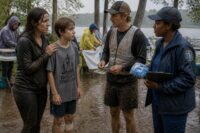
The sky was already threatening rain the morning of the charity relay—the sort of Missouri spring gloom that can’t decide between a drizzle and a downpour. The riverside park teemed with volunteers in ponchos taping up soggy banners, runners shuffling nervously under awnings, and a single bullhorn crackling into the gray air, shooing teams to the starting line.
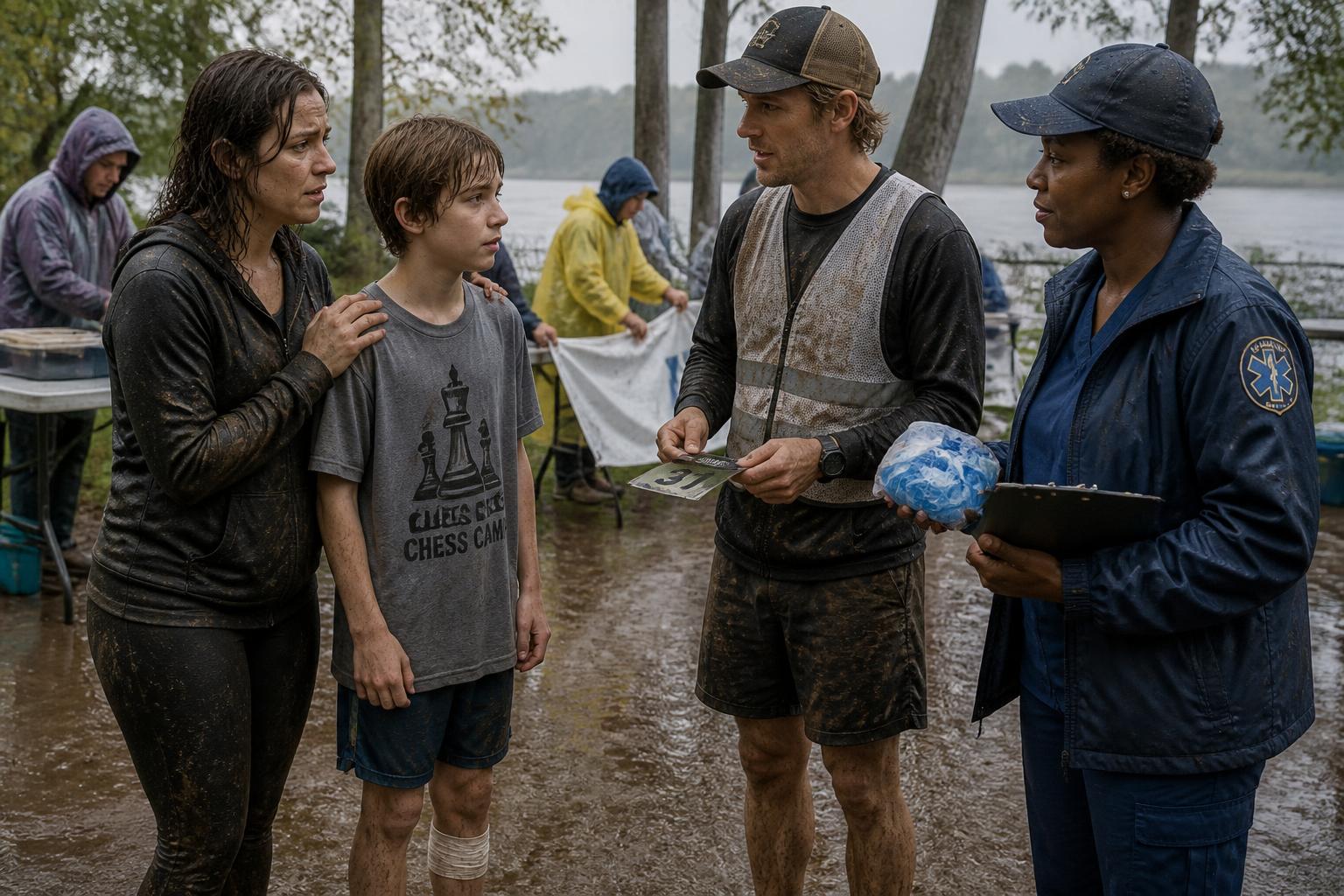
Beth juggled a mesh gym bag, coffee thermos, and Sam’s uneaten granola bar as they checked in with a harried volunteer. April—sporting a rumpled navy windbreaker over her EMT vest—cut through the crowd to offer them bandage packets and a self-effacing half-smile. “Could've picked a better day for heroics,” April grumbled. Thunder rolled somewhere upriver; the organizer’s clipboard dripped water onto his shoes.
Sam was uncharacteristically jittery. His jaw clenched in that focused, adolescent way Beth knew signaled nerves. “Stay loose, honey,” she said, squeezing his shoulder. “It’s just one lap each. We’re not running Boston.” But her own smile trembled under the weight of expectation—for herself, for Sam, for whatever this day might ask of old friendships grown thin.
The course itself had become a patchwork of puddles and gravel washouts. As teams lined up, Beth saw Kevin, arms crossed, his partner conferring frantically with a volunteer. Kevin met her eyes across the crowd. He started to raise a hand, maybe to wave, but seemed to think better of it and adjusted his cap instead. Beth’s stomach somersaulted.
After a garbled warmup over a speaker, the first runners took off—some in a burst of determined speed, others in cautious shuffles. Beth and Sam waited, wrists stamped with bright ink, bodies tense beneath the drizzle. Sam rolled an ankle on a slick root during a warmup lap, face pinching with surprise and pain. He tried to brush it off, but as the time for their wave approached, Beth saw the growing limp, the forced bravery in his grin.
“I can still do it, Mom—seriously.” Sam flexed his foot, stubborn but pale.
Beth crouched, checking his ankle with the thoroughness of a mother and a librarian used to patching more than books. “Sam, it’s swollen. I’m not risking this just for a charity run. We’re out.”
He protested, tears of frustration welling, unspoken worry flickering behind his defensiveness—afraid to let her down, or to back out when he’d been the one to sign them up. Around them, runners hustled to the handoff zone. Beth’s certainty wobbled. For a moment, she almost gave in.
Kevin appeared at her elbow out of nowhere, sweat already streaking through drizzle on his brow. “Everything okay?”
Beth startled, then shrugged, glancing at Sam. “Twisted his ankle. I guess we’re about to bow out.”
Kevin squatted next to Sam, gentle in a way that reminded Beth painfully of the boy he’d been—quick to crouch at a friend’s side, to offer a ridiculous dare or an easy laugh. “No shame in quitting with an injury, man,” Kevin said. “But if it’s about keeping your team in…I could fill in. If Beth’s okay with it?”
Beth hesitated, resentment and relief mingling. The simplest answer was no, but she met Kevin’s earnest, slightly sheepish look—something vulnerable, almost regretful, in the tilt of his mouth. “You don’t have to—”
Kevin shrugged one shoulder, affected nonchalance. “No hard feelings. I’d like to help. Start clean, you know?”
Sam nodded, grateful and embarrassed. “Thanks, Mr. Braddock.”
Beth nodded, pulse thudding as Kevin took Sam’s race bib. They lined up in the relay corral, pausing as April jogged over. “He’s in good hands, Beth,” April assured her, brief squeeze on Beth’s arm belying all the unsaid history.
As the race resumed, Beth and Kevin fell into step on the muddy trail, exchanging cautious glances. By the halfway mark, the rain had picked up, drumming on their shoulders. Their pace matched awkwardly but steadily, their old habits warring with muscle memory and residual distrust.
Kevin was the first to break the silence. “I’ve been meaning to say…I was an ass in high school. And later. I said things I shouldn’t have. I told April stuff you told me in confidence. I messed it up.”
Beth side-eyed him, breath catching. “I know. So did I. I never should have called you what I did, in front of everyone.” The admission burned her throat.
For a moment, they ran without talking, the slap of their shoes uncomfortably loud. Kevin cleared his throat. “You think we could do better this time? Start from what’s left?”
Beth managed a dry smile. “I guess there’s not much left to lose.”
They ran, shoulders brushing, the river wind biting and the park’s sodden crowd cheering in the distance. Something unfamiliar bubbled up in Beth—a fragile hope, patched together with honesty and the willingness to try, scars and all.
The finish line loomed ahead, a winding slip of orange cones and cheering clusters blurred in the rain. Underfoot, the grass dissolved into oozing brown clay. Beth launched herself through a last patch of mud, adrenaline burning away the ache in her legs. Kevin was right beside her, splattered to the knees, grinning like it was old times—like the years and hard words had never come between them.
They didn’t win. Not even close. The clock flashed a time she hoped Sam hadn’t noticed, but the exhaustion in her chest was edged with something bright: relief, pride, and the electric sense of having made it through together, battered but unbroken. Kevin whooped as they crossed the line and flung an arm around her shoulders, laughter spilling out of them both—genuine, unguarded, alive. Beth doubled over, gasping for breath, her hair matted to her face, and felt the last of her old resentment wash off in the rain.
April was waiting beyond the finish, windbreaker soaked and clipboard abandoned. She grinned—really grinned, wrinkles crinkling in the corners of her eyes—and thrust a damp hand toward Beth. “Still standing! That’s what matters,” she shouted over the hubbub. Kevin, still laughing, took the proffered bottle of water and nudged Beth gently. “You were easy to chase, Russo. Good thing you’re such a sore loser. The kid would’ve out-sprinted both of us.”
Sam hobbled over from the sidelines, ankle wrapped and face flushed with secondhand triumph. “You looked ridiculous,” he told Beth, but his smile was shining, full of pride. Beth wrapped him in a muddy hug. The applause faded, then organizers started packing up, the race’s chaos settling into a scatter of empty cups and laughter drifting on the breeze.
April came up beside them, arms crossed, the lines of care on her face oddly softened by the morning’s challenge. “You know, I put in my notice last night,” she said quietly, almost as if confessing a crime. Beth’s eyes widened. “You did?” Kevin blinked. April shrugged, a tremulous smile breaking through. “I want to see if there’s more out there. Maybe closer to what I used to want. Watching you guys… I don’t know, it pushed me. If you can face your ghosts and muddy shoes, I can try something bigger. Even if it scares the hell out of me.”
Beth squeezed April’s cold hand, grateful for the trust—and for the comfort of not being alone in uncertainty. “If you need a reference, tell them I’ve seen you handle much messier emergencies than this,” she said, earning laughter all around.
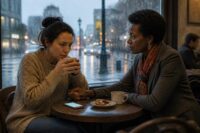
The four of them drifted to the coffee shop on Main Street, still dripping, smuggling in their wet sneakers and battered pride. No one minded the mud tracked between the tables. April fetched a round of hot drinks, and Kevin wrangled extra napkins from the counter. Sam perched beside Beth, face brightening with each sip, his earlier embarrassment replaced by quiet contentment.
Outside, the windows misted with rain. Inside, conversation found its rhythm—tentative at first, then gathering warmth. Kevin and Beth swapped stories about high school races and car engines and the absurdities of adulthood. April’s eyes shone as she imagined what might come next. Even Sam, usually reserved, ventured opinions on which teacher was most likely to fall during a charity run and whether Beth’s running form was a crime against nature.
For a while, the past hung between them, not vanished but thinned. Forgiveness hadn’t rewritten history; it just softened the edges, making space for something new. Wounds remained—old arguments, missed chances—but now, in the quiet river light, they became part of the story instead of the end of it. Beth accepted the ache and the hope together, realizing that second chances didn’t mean pretending nothing bad had ever happened. It meant looking at each other—mud, scars, regrets and all—and choosing, despite everything, to move forward.
As the rain eased and the sun pressed a reluctant gold edge along the horizon, Beth looked around the table: her son flush with hope, April daring to dream again, Kevin’s eyes alight with tentative ease. Outside, the Mississippi rolled patiently on, as indifferent as ever. Inside, the world felt—just for a moment—full of morning, second chances, and the promise that this time, maybe, things would hold.