







Fiction: This is an original fictional story. Characters and events are invented.
Nora Whitaker’s tires hissed against the wet pavement as she rolled past the granite sign for Branfield, Connecticut. She’d forgotten how green everything stayed here, even in May’s uncertainty—ferns pushing through last autumn’s leaf rot, tulips in dark beds lining the road. Her mother’s neighborhood felt suspended, unchanged even as platinum sedans parked where the neighbors’ Chevys once had. Up the sloping drive stood the old Whitaker house, smudged by recent rain, bay windows reflecting clouds, and the painted gingerbread trim a little duller than Nora remembered. The sight hurt more than she’d prepared for.
She parked beneath the dogwood tree and sat still, knuckles aching where she gripped the steering wheel. The trip had been a rush, packed with calls from hospitals, Eric’s brief texts—She’s home. Mostly resting. Come soon.—and fading worries about deadlines back in Boston. Now, in quiet Branfield, even the crows seemed to hush as she stepped onto the path, suitcase wheels whispering over flagstones.
Inside, the house was familiar and not. The stairwell’s banister, shiny and oak-dark, greeted her, along with the scent of lemon polish, hydrangeas left wilting in a vase, and a hint of something medicinal. Somewhere past the foyer, Nora heard her brother’s voice. Eric appeared, lanky and red-eyed, though he smiled when he saw her.
“Hey, stranger. You found us.”
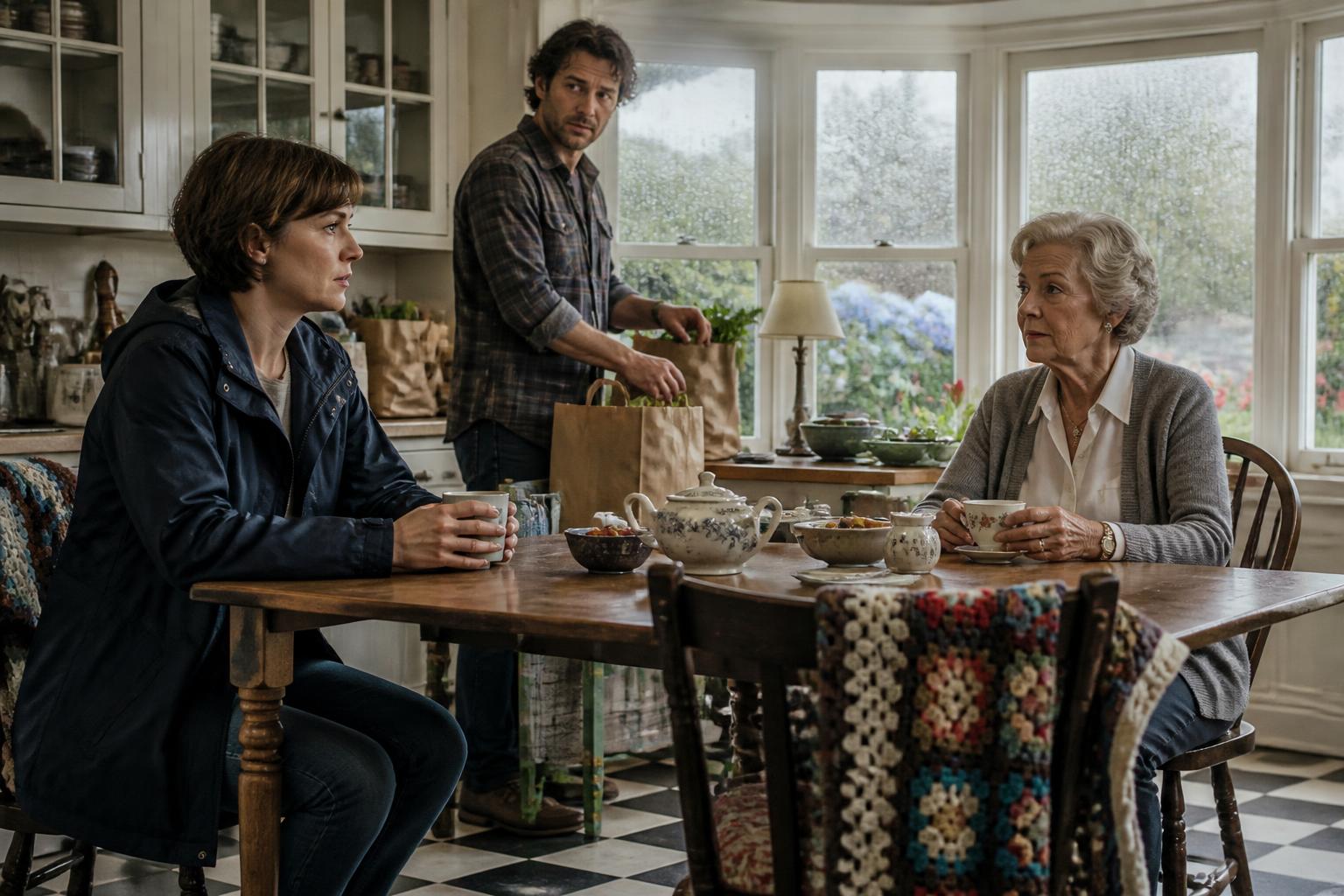
He grabbed her bag before she could argue. Already, Nora felt off-kilter; Eric had always let her manage her own things, but he seemed intent now, bustling her through the echoing hall toward the kitchen. There, sunlight glazed the checkerboard floor. Their mother, Eileen, reclined at the little table by the window, pale but regal in an ironed blouse, her left hand trembling as she lifted her mug.
“Nora, sweetheart.” Eileen’s voice was thinner, but her eyes looked Nora over with familiar appraisal—tallying travel, lost sleep, the squeeze of city life within the lines around her mouth. “You came sooner than I expected.”
Nora brushed a kiss to her mother’s faded curls. “How are you feeling?”
“Ready to be rid of this house arrest. Eric’s taken to making hospital corners.” There was pride in her smile, but her fingers twitched compulsively at the mug’s handle.
Eric grinned, rolling his sleeves. “Don’t let her fool you—she likes the attention.” There was affection there, but something else too, coiled beneath his words. Nora watched their mother’s face stiffen and wondered if the house’s ceiling heights—or old stories—pressed in on all of them now.
They passed the afternoon in perfunctory reunion. Nora prepared Eileen’s tea, fetched medication from the floral tin in the pantry, and answered practiced questions about her life in Boston: client names, rent, whether she’d seen snow in April. All the while, she kept glancing at surfaces that felt off: the locked desk in the study, a sealed drawer in her father’s old armoire, the sharp click as Eileen shut her bedroom door behind her mid-afternoon, “for a nap.”
Later, Nora helped Eric sort through paper bags of groceries, both standing side by side in the cavernous kitchen. He seemed tired but more rooted than she remembered—his hair messier, a handled mug with his initials by the sink. The undercurrent of frustration was obvious as he recounted their mother’s resistance to new routines and short silences that lingered after she left a room.
“She barely lets me help,” he muttered, loading cans onto a shelf. “But at night she calls for me if she can’t sleep. I asked about bringing in more care, but she said the neighbors would talk.” Something bitter flashed in his laugh. “Classic Eileen.”
On her way upstairs, the worn pattern of the stair runner felt odd beneath Nora’s feet. Her old room had been made up as if she’d only been gone a weekend—bedspread taut, books lined up exact, but her graduation tassel missing from its place on the desk. She opened her suitcase quietly, straining to catch familiar sounds, but the house pulsed with an uneasy silence punctuated by the low hush of kitchen voices below.
Standing at the turret window, Nora watched evening fall blue over lawns and hedges. The Whitaker place had always been a point of pride in town—five bedrooms, slightly overgrown gardens, rumor of secret passages. She’d never meant to be gone this long, she thought, or to leave Eric shouldering so much.
Later, as she passed the study, Nora noticed her mother standing inside, rifling through the locked desk, then hastily shutting a drawer when she saw her daughter watching. Eileen offered a paper-thin smile: “Just looking for an address. Go get some rest, darling.”
Nora nodded, her heart beating a little faster with something like dread or anticipation. Behind every echo in this house, she now felt, was the question she’d long avoided: why she left, and why she’d really come home.
Morning in Branfield broke with a pale, persistent drizzle, keeping the air close and the house colder than it should be for late spring. Nora woke before the others, creeping past Eric asleep on the sofa—he’d given her his old room, claiming he liked the quiet downstairs. Sunlight tried its best through the front windows as she brewed coffee, the clatter of the percolator oddly amplifying the silence.
They spent the day in fits and starts, circling each other in the effort of being helpful. Eileen, propped on the chaise with crocheted blankets at her knees, directed efforts with clipped precision, her tone brooking little argument but often trailing off when something caught her memory. They cleaned out linen cupboards, sorted expired medications, and by noon, Eric suggested tackling the attic: “We haven’t touched Dad’s boxes in years.”
Nora’s heart sank—the attic had never been her territory, its eaves close and sloped, full of mothballs and the thick scent of old paper. Eric led the way, flashlight in hand. Dust motes danced ahead as they climbed. The attic’s familiar chaos greeted them: trunks, cardboard cartons with their father’s tiny, spidery script, stacks of books tied with baling twine. In one far corner, a battered armoire leaned into the wall. Eric pulled at a warped drawer, freeing it with a grunt and sending something clattering to the floor.
A slim envelope, yellowed and sealed with a faded blue sticker, had slipped behind a box. Nora stooped to pick it up, frowning at the unfamiliar handwriting. Inside she found several letters—postmarked 1983, addressed to someone named “Marian T.” and signed “R.” Tucked with them was a black-and-white photograph: a teenage girl in a homespun dress, dark hair clipped back, smiling at the edge of someone’s orchard. Nora turned it toward the attic bulb’s muted light. She’d never seen the girl in any family album.
“Do you…?” she started, handing the photo to Eric.
He shook his head. “I don’t recognize her, but the letters…” He took them, scanning quickly, mouth pressed thin. “None of this fits.”
Downstairs, Eileen’s voice called for water. Nora carefully pocketed the photo. Later, when Eileen was settled again—with tea and the window thrown wide to let in the wet air—Nora broached the subject, holding out the envelope.
“We found this in the attic. Do you know who she is?”
Eileen’s expression shuttered almost instantly. “Old family friend. That’s all. Some things are best left…” She trailed off, gaze fixed on the gray yard. “If it’s just old letters, there’s no reason to dwell. People come and go.”
It was a brush-off Nora remembered from childhood—final, but weighed with something more fragile now. “Are you sure?” she insisted. “It doesn’t seem like she’s related?”
Eileen’s lips tightened. “I’m tired, Nora. Let it be.”
Eric cornered his sister that afternoon, voice low as they restored keepsakes to their boxes. “I’ve always thought there was something off. When Dad died, Mom boxed up a bunch of stuff herself. Remember how she didn’t let us help? There’s the desk she always locks, too. I asked her once if we had family in Europe and she got flustered.”
They reconvened in the study after Eileen napped, compelled by a mutual urgency. The desk key, predictably, was missing, but Eric fished out a ring of old skeleton keys from the mudroom drawer. After several attempts and a curse as another key bent, one finally clicked.
The drawer held only a tidy clutch of papers, an ornate birth certificate on thick, creamy paper, and a pair of clipped newspaper stories, the newsprint browned at the edges. The document listed a newborn girl—Lillian Marian Tisdale, born December 4, 1983. The mother: Marian Turner. Father: left blank. Nora felt prickles bloom behind her eyes as she handed it to Eric.
He stared at the page, then at the photograph. “Tisdale? Not a family name,” he murmured. “Is Mom hiding another branch of the family?”
They spread out the news clippings on the faded rug. The headings blurred, but one stood out: TEEN PREGNANCY AT BRANFIELD HIGH STIRS CONTROVERSY, June 1983. There were no full names, though it described a “local girl” and the ensuing hush that fell over the town. Another, from 1985, mentioned an adoption handled privately through a church intermediary.
Nora read until the words swam. “Someone connected to us. Why hide it? And why keep the photograph?”
Eric’s eyes were unsettled, haunted. “What else haven’t we been told?”
The air in the room felt close as Branfield’s old secrets pressed in from the eaves and floorboards. Nora rose, turning the photograph over in her hand until it trembled. She heard her mother’s slow tread in the hallway below and realized there were pieces of Branfield—of their family—they barely recognized at all.
The next morning, Branfield’s sky was a low pewter lid, and the Whitaker house seemed steeped in the same tension that shadowed Nora since yesterday’s discoveries. After a breakfast of toast and marmalade, brittle with politeness, Eileen settled herself at the parlor window, knitting needles clicking. Eric retreated to the garage under the pretense of searching for an old tarp; Nora sat on the stairs, thumb stroking the milky paper of the birth certificate.
She found her mother alone, the usual armor of authority worn thin. For a minute, silence. Eileen’s hands hovered above her knitting, missing stitches, as if she already sensed Nora’s questions.
“Mom,” Nora said quietly. “Do you know—about Lillian Marian Tisdale? The birth certificate?” The word itself sounded foreign in this familiar, echoing space.
Eileen’s jaw trembled. For a full ten seconds, Nora thought she might deny everything. Instead, Eileen sank further back in her chair. “Oh, Nora,” she whispered. “Your father was a complicated man. We both were.”
Eileen worked at the truth slowly, as if unspooling knotted, delicate wool. In 1982—years before Nora would recognize in her parents anything like vulnerability—her father had spent time volunteering with St. Anne’s church outreach. There, he’d met Marian Turner. She was seventeen, a scholarship student from a struggling family. Eileen’s hands balled in her skirt. “Your father… he cared for Marian in, ah, an improper way,” she murmured. “It wasn’t—Lord, it was not love, the way you or I would talk about it. But it happened. Your father told me after. Swore it was brief, over by autumn.”
Nora’s throat felt tight enough to snap. “And the baby?”
“Marian’s child. She—she couldn’t keep her. Her parents were strict Catholic, opposed to scandal, so she went away for the end of her pregnancy. The baby girl, Lillian, was placed with a Branfield family who agreed to raise her as their own, on the understanding Marian would move away. But Marian stayed—worked at the market for years. The Tisdale family raised the child.”
Eileen’s eyes glistened with anger at herself, at the world. “Your father asked me to keep silent, for the good of the family. He feared what it would do to Branfield’s perception of us—and of him. I chose to keep it, too.”
Nora pressed her fingers to her own cheeks, cold with shock. “So she’s here? Our sister? Does she know?”
“I don’t believe so. Marian passed away when the child was young. The Tisdales were good, discreet people. But this town… people remember, even when they say they don’t. It was always understood that certain things wouldn’t be discussed. Safer for everyone.” Eileen’s voice faded. “I kept those papers as a penance, Nora. I never met the girl.”
Eric appeared at the parlor entry, the garage search abandoned, eyes wide and ringed dark. “You’re saying we have a sister in Branfield? You kept her a secret from us our whole lives?”
Eileen bristled, but guilt was unmistakable. “It wasn’t my intention to hurt you. I—” Her words fell apart. “I thought it would pass, that the past could be stored away like old linens.”
Eric ran a hand through his hair, his voice thick as bramble. “So all this time, I thought I was keeping this family together, but—God, it feels like none of it’s real. Were we even a family, if he had another child?”
“You are my son,” Eileen said fiercely. “That has never changed.”
Nora forced herself to steady. “But what if she’s living right here, never knowing? Aren’t we—don’t we have a right to know her?”
The rain thickened outside, indistinguishable from the noise inside Nora’s mind. Eileen drew herself up. “If this comes out, it won’t just unsettle us. Branfield remembers everything. There’d be whispers—about your father, about Marian, about us. We’ve survived enough loss. I can’t bear another brand of shame for you children.”
But Nora, once an expert in compartmentalizing what hurt, felt something else—an ache almost like hope. “I need to meet her. I have to know who she is.”
Eric, silent, rubbed at his eyes. “I don’t even know what I’m supposed to feel. Or say. Is she… is she even my sister?” He shook his head. “I just thought there were things that made us Whitakers. What if it’s all brittle? What if she deserves what we’ve had?”
The three of them sat together in the muted morning, carrying the weight of old choices and new knowledge, the storm outside now a dull and unending drum.
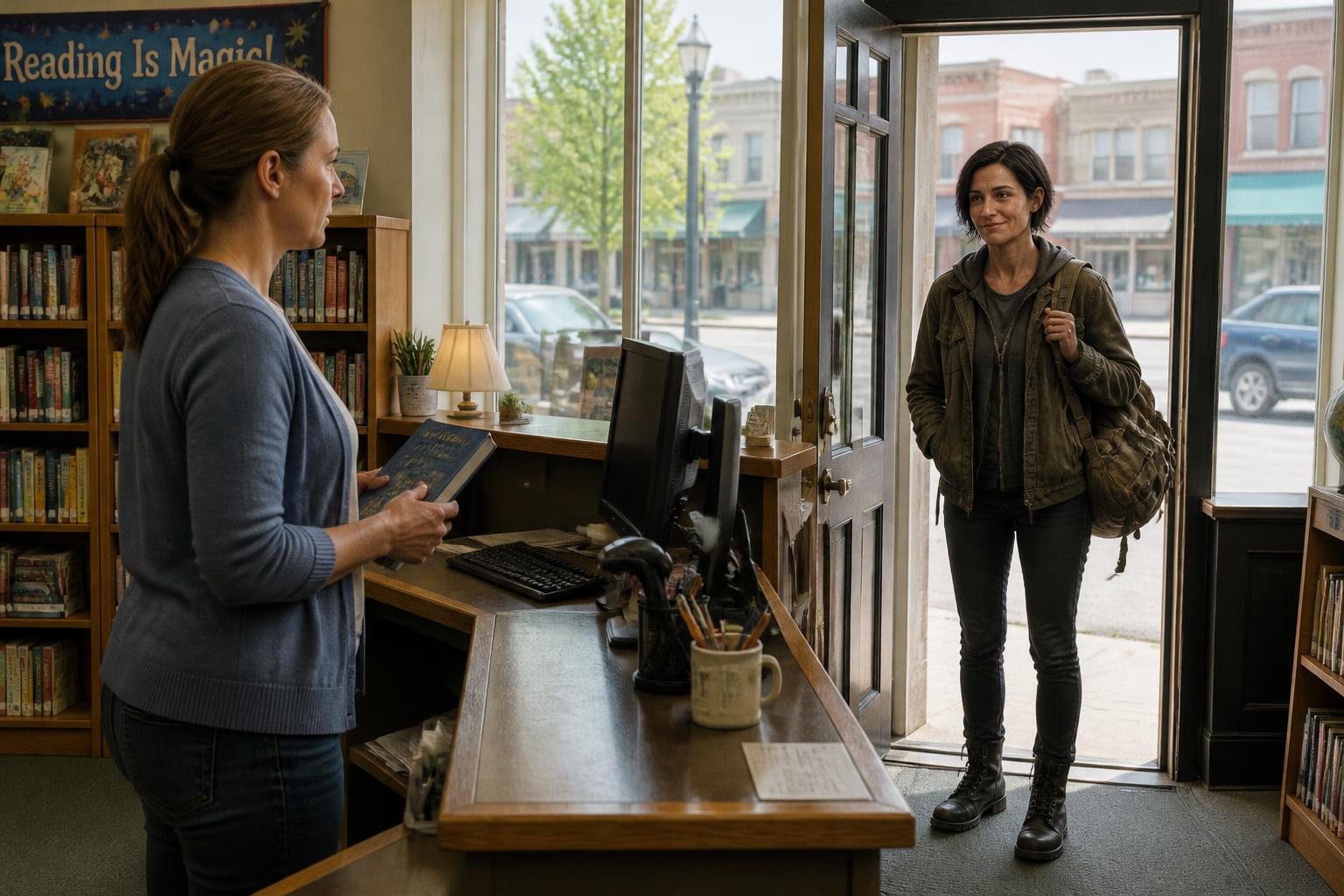
Nora’s research led naturally—inevitably—to the Branfield library. She hesitated outside, hands sweating inside her pockets despite the day’s chill. Inside, the lobby’s hush pressed in, the carpet muffling her steps as she approached the research desk where a dark-haired woman paged through returns. The nameplate read: Lily Tisdale.
Lily looked up at Nora with a flicker of guarded curiosity. Close up, she was neither quite the woman from the old photo nor entirely a stranger. Her face was strong, her hair clipped back just so, and something wary but open haunted her gaze. Nora’s heart lurched; the distance between two people could be so short, and unbearably long.
She cleared her throat. “Hi. My name’s Nora Whitaker.” She tried, failed, to muster a smile. “Could we talk somewhere private?”
Lily’s posture stiffened. “Is this about a research request?”
“It’s… about you. And my family.” Nora’s voice went thready. “I know how that sounds, but—please. It matters.”
Lily took a deep breath, scanned Nora’s face, then nodded tightly. “There’s a staff room in back. Give me a minute.”
The room was small, with old winter coats on hooks and a gurgling coffee maker. Lily perched warily on the edge of a folding chair. Nora found herself clutching the birth certificate, now creased soft from handling.
“If you’re about to tell me I’m a long-lost cousin,” Lily said, “don’t. I’ve always known something was off—my parents never talked about how I came to them.”
Nora swallowed. “You’re… not a cousin. You’re my sister.” She laid out the documents, the photo, hands trembling. “My father—our father—was Richard Whitaker. Marian Turner was your mother. We found this in the attic.”
For a moment Lily only sat, silent and ashen, eyes pinned to the birth certificate. She made a small, choked sound, then pressed her hands together until the knuckles blanched. “I always wondered. The Tisdales were good people, but there was something—missing. I thought maybe… but then I pushed it down.” She looked up. “So. You’re my family.”
“We are.” Nora blinked away shame and relief. “Eric’s my brother. I want… I don’t know what I want, honestly. But you deserve to know.”
Lily exhaled, something close to a laugh escaping. “I work with your mother at the historical society meetings sometimes. She’s always so proper. I can’t believe—”
“She didn’t want to hurt anyone. But the secrets—” Nora trailed off. “It doesn’t make right what was done.”
They stared at the old photo together in the hush of the staff room. Eventually, Lily said softly, “What now?”
“Would you meet my brother? Maybe talk with our mother. Just… see.”
Lily considered, then nodded, a strange determination now lighting her face. “I think I want to see her, too.”
The next morning, Nora sat with Eric in the Whitaker kitchen, hands curled around coffee. She described the meeting, the tentative bridge forming. Eric was subdued, still hurting but resolute. “She’s one of us. Whether or not she wants to be.”
Lily arrived at midday, hugged her corduroy bag to her chest as she stepped into the old house. Eileen stood by the parlor doorway, eyes glossy, posture rigid. The siblings took seats, cautious in their choreography, all four facing each other beneath the silent gaze of ancestors in oil portraits—strangers and now not so strange.
There were awkward silences, confused laughter, and, finally, hard words. Eileen apologized, her voice fragile but honest, saying, “I was scared to bring more pain. But silence just made it worse.” Eric offered a trembling hand. Lily, blinking back tears, said, “I grew up down the street from you. I always wanted sisters.”
Lunch was homemade soup and careful stories. No one pretended anger wasn’t there, or that love would happen overnight. But the table was fuller. As rain drummed the roof, the house felt less haunted, more lived in. Branches of conversation formed—school recalls, favorite local haunts, how to mend a garden hedge run wild with honeysuckle.
Afterward, Nora lingered with Eileen in the parlor, where late sun finally found its way through gray clouds. “Are you all right?” she asked.
Eileen smiled, wan but real. “I think I am. There’s so much to be forgiven, but maybe that’s how we become family again—not by pretending, but by starting over.”
Eric clattered in, holding Lily’s first childhood library card. “There’s so much I want to learn,” he said. Lily grinned, shy yet expectant, and Nora felt something loosen inside her. Not easy, not complete, but a beginning.
Outside, all of Branfield shimmered with the fresh-washed hush of late spring. Nora gazed out at the sodden hydrangeas, then back at the animate faces gathered in their old home, and saw in the fragile web between them the ordinary, difficult miracle of a family rewritten—and, at last, redeemed.