








Fiction: This is an original fictional story. Characters and events are invented.
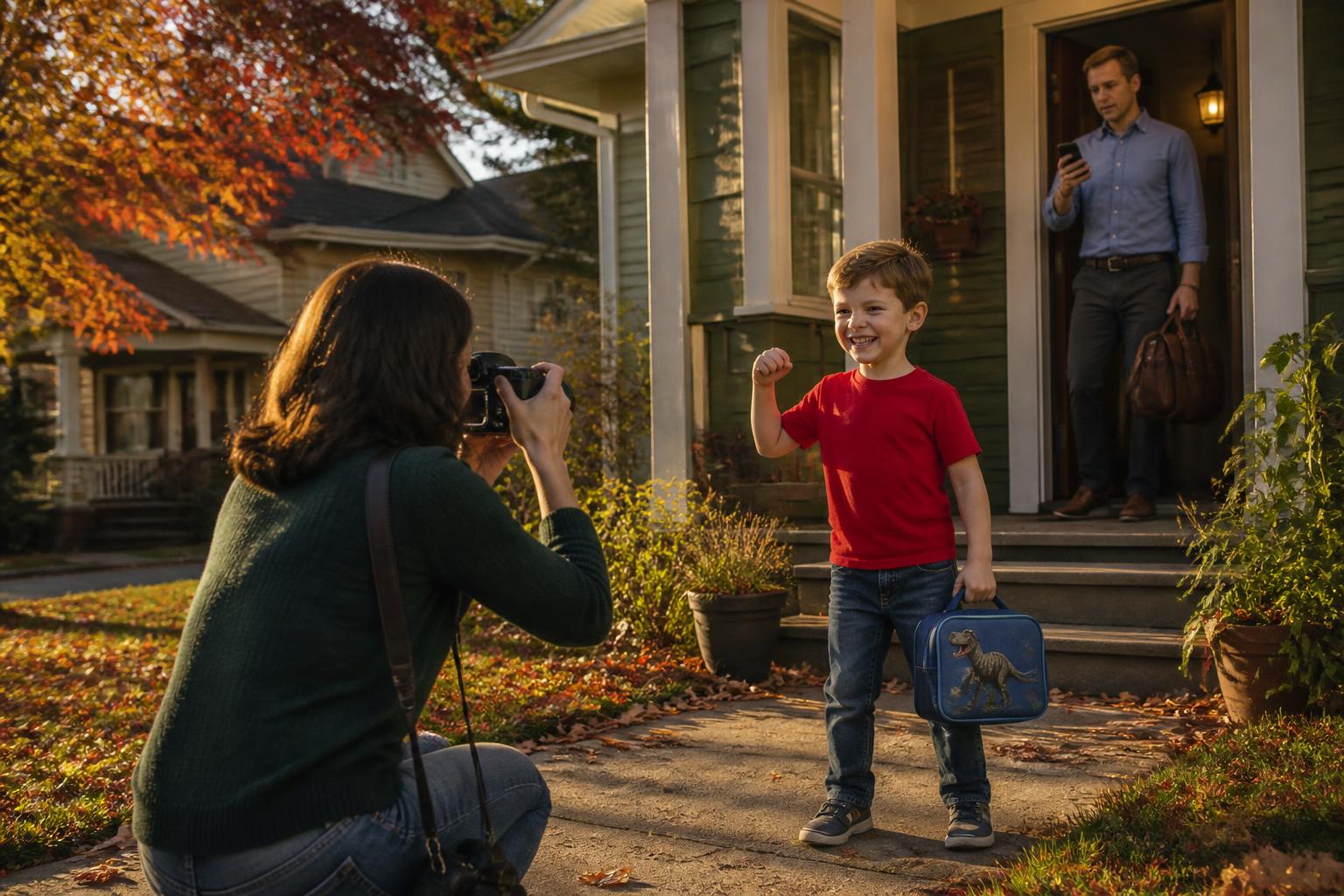
Late September sunlight filtered through the red maples, casting restless shadows along the sidewalk as Jessica Hilliard knelt to snap Eli’s picture in front of their porch. He grinned through a missing front tooth, balancing his favorite dinosaur lunchbox on one knee. She squeezed the shutter, listening for the click that always felt a little like evidence, like proof that the slow accretion of ordinary days might one day matter.
Behind her, Mark emerged from the house in his pressed button-down, phone already flashing with early emails. Jessica rose, brushing grass from her jeans. “Hey, don’t forget—open house at school tonight,” she called over her shoulder.
He nodded, distracted, typing with his thumb while murmuring, “I’ll try. There’s a city meeting I might not get out of.”
Eli groaned theatrically. “Dad, you promised you’d come see my rocket poster!”
Mark knelt, ruffling Eli’s hair with one hand, his phone in the other. “I know, bud. I’ll be there. Might just be a little late, okay?”
Jessica caught the gentle exasperation in Eli’s voice as they walked toward the minivan. Nine o’clock—the school open house—was still a world away. She loaded Eli’s backpack, managing a smile for Mark as he slipped past her. “Maybe after,” she said, “we can grab a slice at Loring’s. Like last year?”
Mark hesitated, eyes drifting to his phone again, then smiled—something practiced but soft. “Yeah. I’ll text you when I’m headed out.”
The engine cut into the hush as Jessica watched him back out, a familiar pang settling behind her ribs. She stood by the porch, waving to their son through the window, watching autumn leaves rattle on the cracked sidewalk. The rhythm of their marriage had shifted in small, uneven increments—too fine to see in a single day, but unmistakable over time.
Later, Jessica returned to her makeshift studio in their sunroom, clearing cluttered memory cards and plotting out shots for her upcoming exhibit. She found herself losing time among glossy proofs and rough sketches, each print a concrete anchor in a day otherwise defined by uncertainty. Her project—a series on fleeting urban moments—had started as a diversion, an excuse to wander Minneapolis with her camera and hunt for overlooked stories. But the deadlines loomed, the curation process felt like gambling, and her nerves sparkled with something between anticipation and doubt.
It was Sam who jolted her back to reality. Their neighbor for six years, Sam lived in the blue Craftsman next door, and lately he’d become an indispensable sounding board. He knocked gently on the back door, holding out a fresh mug of coffee. His grey T-shirt carried a dusting of sawdust from some ongoing project. “Fuel for the tortured artist?”
She grinned, grateful. “I’ll take all the fuel I can get. You ever try making order out of chaos?”
Sam shrugged, perching on the steps leading into the studio. “That’s half my job fixing up this house. Chaos keeps winning. Want me to look at that sequence you mentioned?”
Jessica hesitated, then slid a stack of prints toward him. As he leafed through the photos—street buskers under neon, midnight rain on Nicollet Mall—she relaxed, watching his brow furrow in concentration. Sam always asked the right questions, gentle without being indulgent. She’d found herself telling him things she didn’t even share with Mark—small doubts, creative misgivings, flashes of wonder when the light was just right.
She wondered, sometimes, where the boundary was between camaraderie and something deeper. But that afternoon, as the sun angled across their kitchen table, it seemed easier not to define it—just to bask in the rare comfort of being understood.
With evening gathering in the trees, Jessica roused herself to prep for the school open house. She dressed Eli in a slightly wrinkled polo, wrangling his hair into order, then hustled them to Minnehaha Elementary under a sky bruised violet with dusk. Mark texted at 6:30—”Delayed, but coming soon.” She closed her phone, feeling the ache of a familiar script.
The cafeteria hummed with parents and science posters. When Mark finally arrived, tie askew, eyes shadowed with fatigue, Jessica caught the half-beat Eli’s face took to light up. She snapped another photo, just to hold the fragile moment in her hands. Later, as they walked out to the parking lot, Mark’s arm brushed her shoulder, gentle and almost absentminded. Overhead, the river of headlights pulsed, carrying them home beneath the restless city sky, each holding quietly to what they couldn’t quite say aloud.
The following afternoon, Minneapolis unfurled warm and gold, just crisp enough to require a jacket. Jessica packed a sandwich and her camera, intent on catching dusk down by the river for her exhibit. She paused in the hallway, listening for Mark’s voice through the walls. The house, however, was empty—just Eli’s discarded socks, Mark’s unread mail stacked in crooked towers, and her own persistent worry.
She was kneeling to tie her boots when she noticed an extra set of car keys missing from the hook by the door. That shouldn’t matter, she reasoned—Mark sometimes switched cars for work. Still, a small pulse of curiosity nagged as she slung her camera bag over her shoulder and stepped out into the reverberant hush of afternoon.
Three blocks from their house, Jessica’s route to the riverfront cut through a tangle of cafés and old supply stores retrofitted for co-working space. She moved by habit, eyes making sketches, cataloguing fogged windowpanes, late flowers in sidewalk planters, a violinist warming up in the alcove beside Franklin Avenue. She wanted to capture the humming, careless energy of city life—how it both distracts and consoles. Her phone vibrated—Sam, asking about framing paper for prints. She thumbed a quick reply, promising she’d swing by later.
As Jessica angled down an alley, intent on the last gold sparking off warehouse walls, she froze. Across the street, framed in the glass of a corner café, Mark sat opposite a woman she didn’t recognize. The woman had crisp auburn hair, half-tucked behind one ear, bright against the dun shadows inside. Jessica’s hand drifted to her phone, camera forgotten. Mark leaned in, gesturing, smiling—his posture open in a way she hadn’t seen in months. The woman—Tessa, she’d later overhear—laughed, a silver flash of teeth. Jessica ducked behind a pillar, heart hurrying absurdly in her chest. She snapped a stealthy photo through the glass—pure habit—then winced at herself.
She watched for only a minute more, long enough to clock their easy chemistry, too fluid to be strictly professional. Then Jessica fled, pulse skittering as she crossed the intersection and hurried down toward the river’s edge. She tried to focus on her work, but her shots were off—crooked, restless. Her mind reeled, composing impossible explanations, dismissing them, then doubling back to the image of Mark and that woman.
Back home after dusk, Eli sprawled on the rug with a homework packet, Star Wars ships scattered around him. Mark’s car wasn’t in the driveway, but she heard it rolling in just before nine. Jessica hovered in the kitchen, hands tight on the sink. When he entered, she caught the scent of coffee—different from their usual blend, smoky and expensive.
“You were downtown tonight?” Her question felt too direct even as it slipped out.
Mark blinked, toed off his shoes, slow. “Yeah, had a late consult at Henshaw’s. City team brought in someone new to look things over.”
There was a hitch in his voice—just a fraction, but Jessica had learned to listen for fissures. “I saw you at Market Cafe. With someone—you didn’t mention a new hire.”
He set his briefcase on the counter, his jaw shifting. “Tessa. She’s new, all right. Architectural grad, part of the project’s outreach initiative. I forgot to mention—you know how it’s been.”
Jessica met his eyes, searching. Mark’s gaze was steady, almost too deliberate. “And you just… grabbed coffee?”
He nodded, the air between them thick with too much left unsaid. “She had questions, wanted to talk outside of all the meetings. I’m mentoring her. That’s all.” He tried for a smile, worn and gentle. “Jess, you believe me?”
She managed a nod, more for herself than for him. “Of course. I just didn’t recognize her.”
They stood there, silence stretching. Upstairs, Eli’s voice called for help with a math problem, granting escape. Jessica squeezed past Mark and climbed the stairs, every footstep dense with unease she couldn’t name.
That night, after Eli settled and Mark worked late in the den, Jessica restlessly arranged prints on the dining table. She texted Sam about cropping a cityscape, inviting him over to take a look. When he dropped by, their conversation wound late into the night, laughter shimmying through the kitchen. Sam offered small, warm encouragements—the kind Mark hadn’t voiced in months. Jessica felt the border between work partners and confidants melting, every whisper a little braver, a little more necessary.
Near midnight, Sam gathered his things and paused in the doorway, hesitant. “You’re doing good work, Jess. Try to cut yourself some slack.” His eyes were kind, uncertain, lingering too long. When she closed the door behind him, Jessica pressed her back against it, breath tight, piecing together the sharp corners of her marriage—edges she’d never meant to approach.
The next week broke open with a headline: Riverfront Development Thrown Into Turmoil After Leak. The words blinked from Sam’s phone as he crossed Jessica’s backyard, his expression troubled. He handed the phone over with a wordless nod. Jessica read in silence, heart pounding—a stack of internal city memos had surfaced, exposing delicate negotiations and hinting at potential misconduct. Developers, including the team Mark consulted for, were named.
Jessica held the device, cold. “Is… is Mark in here?” She scanned frantically, breath snagging on a line: Advisers close to the project, speaking under condition of anonymity, confirm the leak originated within a recent city counsel consultation.
“They’re not naming him yet,” Sam said, voice quiet. “But there’s rumors online. The zine wants me to follow up—see if there’s more. I just didn’t want you blindsided.” For a second his familiar, affable warmth faltered, replaced by the grim alertness of someone who’d seen this circle tighten before.
Later, as Jessica stood in Eli’s room folding t-shirts, she heard Mark’s distant voice, clipped and urgent on a call. It became the soundtrack of their evenings—phone pressed to his ear, voice rippling with stress, the sharp click of doors closing behind him. Mark started coming home later, shoulders pinched, sleep hollowing under his eyes. The world outside narrowed; even the low, domestic comfort of dinner together felt menaced by a storm front neither of them could read.
One evening, Jessica met Sam for coffee at a quieter spot uptown, both needing, she pretended, a night away from the headlines. Sam’s hands curled around his mug, nerves visible. “Jess, people are saying Mark’s knee-deep. Not just his name—his emails. There’s a list floating around. If it’s true, it gets ugly.”
She tried to steady herself. “You know him—he wouldn’t… he’s careful. He…” Her voice trailed off, fragmented. Was he careful, lately? Distant, secretive, yes. More honest—or just better at shaping the truth?
Sam reached out, fingers brushing hers before he thought better of it, retreating. “I’m watching out for you—just wanted to say that.” Emotion flickered; Jessica felt exposed, gratitude flickering beneath an ache she couldn’t describe.
Jessica returned home late. The house was dark except for the pale blue splash of light from Mark’s laptop, visible through the den’s glass doors. She hovered, watching him scroll through messages, face tight as a fist. He glanced up, startled, and snapped the lid shut.
“You working late?” she asked, trying for casual.
He ran a hand down his face, weary. “It’s chaos. People are panicking. Clients are lawyering up.”
She wanted to reach out, close some of the yawning space between them, but her hands stayed knotted by her sides. “Is there something I should know?”
He hesitated—handsome, inscrutable, just out of reach. “Not yet. It’ll blow over. I’ve done nothing wrong, Jess.”
Jessica nodded, the taste of doubt sharp on her tongue. Upstairs, she checked her phone again. A message glinted from Sam—a photo of her print, perfectly framed beneath lamplight, captioned You’ve got this. She exhaled, tears threatening behind her eyes. How had she come to crave reassurance from someone else?
The next night, Mark’s phone buzzed across the kitchen counter. Jessica hesitated, then picked it up—guilt and resolve warring inside. A string of messages from “Tessa M” unfurled: quick flares of frustration about the media, anxious jokes, late-night reassurances, lines that hovered perilously close to the confessional. Jessica’s chest constricted. The words were intimate in a way she recognized—words she herself had stopped sending to Mark months ago.
She retreated to the bathroom, hands shaking, phone pressed to her breastbone. She unlocked her own phone. There, not quite hidden, was her thread with Sam. Their messages read almost as a parallel: admissions of late-night loneliness and creative hope, flashes of real longing—nothing overt, but charged just the same.
That night, Jessica sat across from Mark at the dining table, both of them brittle with exhaustion. Silence clattered between them, until finally Mark looked up, jaw set. “I saw your texts with Sam. Went looking for reassurance, too, I guess.”
Jessica inhaled sharply. “You have Tessa. Don’t tell me she doesn’t mean anything.”
Mark’s eyes met hers, battle-weary. “I got carried away. She listened. She saw me. But I never—I didn’t…” He broke off, shaking his head. “It was never physical. I hurt you, Jess. I know that.”
She nodded, tears sliding unchecked. “It’s not just you. I started leaning on Sam in ways I shouldn’t have. But I stopped myself. It didn’t go further.”
They sat with the knowledge, both culpable, both shattered in unspectacular, human ways. Shadows stretched across the table, elongating the distance between them they weren’t sure could ever be crossed.
It took another week before either of them said the word out loud. “No one does this on purpose,” Jessica whispered one sleepless night, twisting the hem of her shirt between restless fingers. “Breaks a thing they promised to keep whole.” Mark was propped on his side, eyes glossy in the dark; he didn’t answer at first. In the old geometry of their marriage, apologies had always been swift, patching over small wounds before scar tissue could grow. But this was different—deeper and messier, a wound knitting at its own stubborn pace.
They agreed, awkwardly and then with mounting relief, to start counseling. Once a week, in a little office hung with watercolors of birch trees, they danced around the splinters and jagged edges, tugging out old disappointments: the closed doors, the missed soccer games, the times ambition had outpaced tenderness. Jessica talked about loneliness—the sort she’d started hiding even from herself—and Mark finally admitted how the riverfront job had swallowed him whole. “I got hooked on feeling important,” he said once, voice low but steady. “Like if I just solved one more crisis, I’d finally be enough.”
Some sessions were raw, voices scraping, tears tripping over bitterness and regret. Others were unexpectedly gentle, buoyed by the small discoveries that they still knew each other’s favorite cereal, still shared a dumb fondness for ‘80s sitcom re-runs. But the counselor’s questions kept circling back—Do you want to fix this, or can you let each other go?—and neither of them could answer with anything but hesitation.
By November the air turned sharp and metallic, and the house settled into a tentative truce. Jessica dove into the final preparations for her photo exhibit, sometimes working with Sam until midnight, the two of them bent quietly over prints and coffee. Mark stepped away from the embattled development deal—handing off files, fielding cold voicemails, and then, finally, submitting his resignation. He applied for a teaching post at a nearby community college, something steadier and less corrosive. “I want to be present again,” he told Jessica one Monday morning, pouring her coffee almost shyly. “For Eli. For myself. Even if it feels—smaller.” She only nodded, but her heart thudded with complicated relief.
The decision, when it came, was not fiery or abrupt. They sat across from one another on their sagging blue couch, the first snow trembling outside, and told Eli together. Mark’s hand found Jessica’s instinctively as they explained: they loved him, always; things would be different, but he’d still have both parents, one house for a while, then two, but family in every room. Eli cried, and Jessica’s heart nearly broke again, but later he built a blanket fort in the living room and demanded Mark read a chapter of their favorite mystery novel aloud, signaling, in his own way, what kind of love refused to be banished.
In the hush afterward, Jessica and Mark lingered in the kitchen, grief and relief threading through their voices. “I’ll always want good things for you,” Mark said quietly, thumb tracing the coffee cup rim. “You’re still my favorite witness to all this,” Jessica replied, gesturing softly at their crowded, sunlit walls—their family, their imperfect history always half-captured in frames.
Jessica moved into a condo three blocks away, sunlight streaming into bare spaces waiting for her art. With Sam, she allowed things to unfold without labels—he came by with dinner, offered rides to galleries, helped rehang her prints. It was a gentle unfolding, a kind of faith she’d once thought herself too tired to relearn. She kept counsel with herself more fiercely than ever, intent on building from strength rather than longing.
Mark flourished quietly in his slower job, rediscovering the pleasure of teaching formulas and seeing a lightness return to Eli’s shoulders. There were still bruises, gnarled places where trust hadn’t entirely regrown, but in the space between them new grace took root—curious, sometimes melancholy, often kind.
At the end of that winter, they found themselves shoulder to shoulder again in a crowded elementary school gym, watching Eli hover proudly beside his science fair poster—”Rocket Fuel: Fact vs. Fiction.” Jessica balanced her camera, catching Mark’s smile as he pointed out statistics to Eli’s teacher. Someone offered to take their photo together and, without thinking, Mark slid his arm around Jessica’s shoulders. The shutter snapped. Later, standing outside in the settling dusk, the three of them huddled for warmth, laughter rising in plumes of breath beneath the streetlights. Not a perfect ending—maybe not even a tidy one—but a portrait of family reframed, changed by fault lines, steadfast in the soft glow of what remained.