







Fiction: This is an original fictional story. Characters and events are invented.
Julia stood just inside the front door, her hands folded tightly under her armpits, watching the curve of relatives making their way into the Squirrel Hill house. She’d spent the early morning rubbing the banister smooth with lemon oil, as if memory could come clean with enough scrubbing. Evan’s arrival—luggage thumping against the porch, his suit freshly pressed in spite of the Amtrak ride—brought with it a chill, but also a strange relief. The scattered branches of the Archer clan were briefly together again, under the awkward weight of loss.
The funeral that morning had been a modest one. George Archer’s memory was threaded through with school teaching stories, community theater performances from decades ago, baseball trivia rattled off until the end. Julia sat up front beside her daughter Madeleine, who dabbed at her eyes with Julia’s scarf more from the effort of keeping it together than true tears. Evan kept his sunglasses on, his wife having stayed behind in Chicago, and Linh—now alone three years since Richard’s accident—held herself with dignified reserve at the edge of the pews. The only sound after the minister’s final prayer was the hush of feet on tile, the murmured condolences of neighbors Julia had barely seen outside the grocery store in years.
Now, as platters from the deli were distributed among mismatched plates in what had once been their parents’ dining room, the grown siblings circled each other. Specters of childhood routine haunted the space: Julia remembered the way her father used to sneak out to the garage during commercials, the old house quiet except for the rattle of pulled-pork sandwiches being assembled. Today, even the light seemed heavy, gray through the leaded glass windows.
Evan made his way to where Julia stood, shrugged out of his coat, and set his phone down pointedly. “So. You holding up?” he asked, tone practical to the point of coldness.
“Nice of you to ask,” Julia said, her voice even. She nodded toward Madeleine, who hovered at the edge of a tray of kugel, listening but pretending not to.
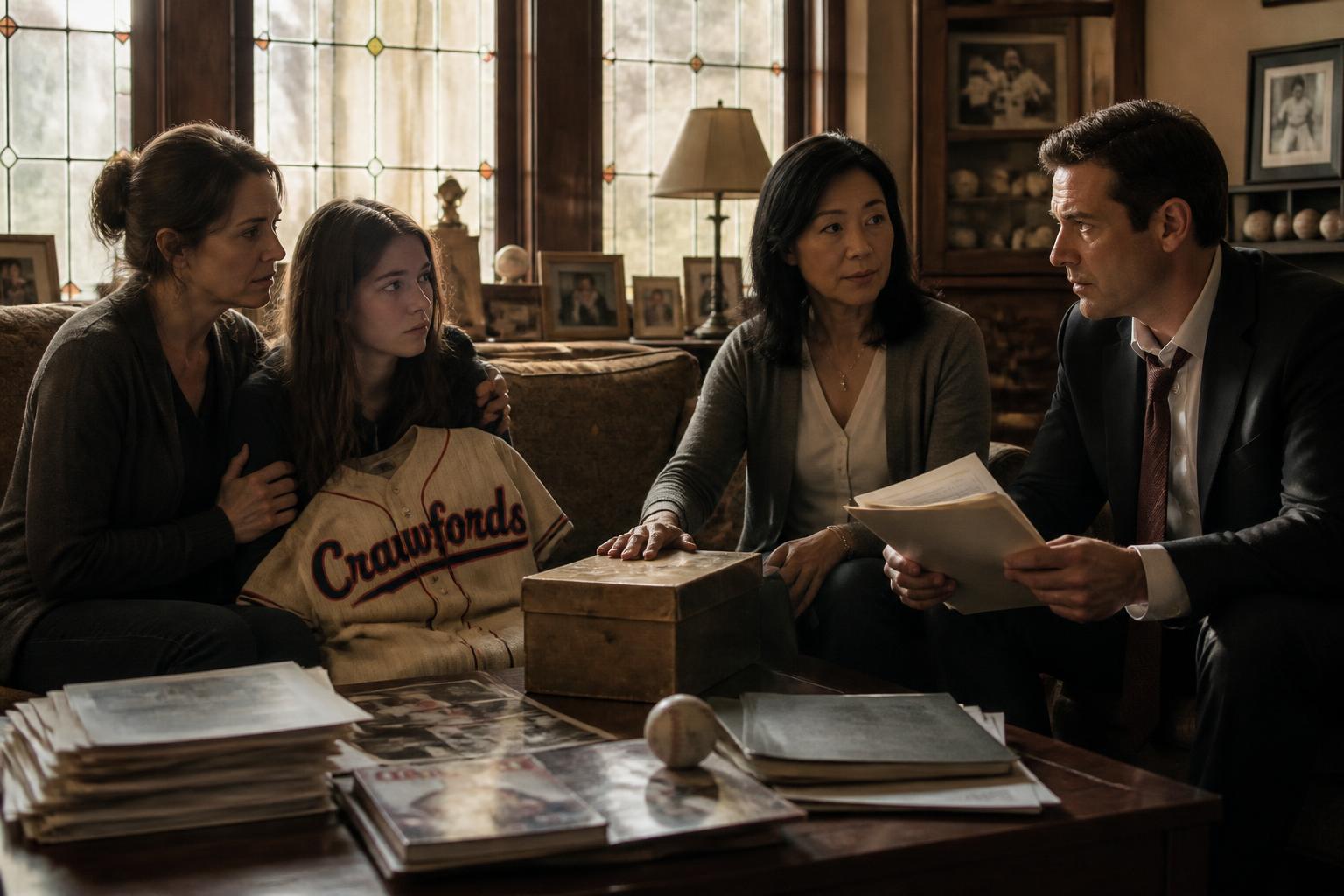
Before Evan could retort, their mother’s lawyer, Mrs. Edelstein, cleared her throat from the parlor. “If the family is ready—we can adjourn here for the reading.” The words stilled the cousins and uncles. Only Julia and Evan, Linh, and Madeleine followed the lawyer into the parlor, where the heavy green file waited on the coffee table.
Mrs. Edelstein perched on the piano bench. “Your father’s will is… elaborate in some respects, and straightforward in others.” She looked over her glasses, shuffling paper. “George leaves the family home—this home—to his surviving children and to Linh as widow of his late son, Richard, as equal joint inheritors. It is my duty to inform you that the Archer baseball collection is also included—not to be sold immediately, per the language.”
She read, “The collection is to be maintained as a family asset, to ‘provide opportunity in the spirit of family.’” She paused there, as if expecting applause or protest. But Evan only tapped restlessly at his knee; Julia absorbed the words, the rhythm of the first line echoing oddly. The collection—triple-locked in her father’s old study—had been the subject of conversations and arguments for years. Rare glove contracts, autographed baseball cards, and one battered Pittsburgh Crawfords jersey that George guarded like a dragon his hoard.
“And the rest?” Linh asked softly, her voice even though her hands trembled in her lap.
“Bank accounts are split as stated,” Ms. Edelstein said. “No disputes there. But the home and the memorabilia—especially the memorabilia—will require collaboration to decide their final destiny. Your father hoped it would be a source of ‘opportunity,’ but leaves discretion to the family, with a caveat against quick liquidation.”
Julia’s stomach twisted. She glanced at Madeleine, whose eyes flickered between adults, trying to read the room. Evan’s lips pulled tight. “So we’re supposed to play happy family until we agree what counts as ‘opportunity’?” he said acidly.
Linh glanced from Julia to Evan, her face composed but wary. “Richard always said your father wanted something good to come from that collection. Not just money. He used to talk about it funding college—or maybe a business, if anyone had a dream.”
“That was George’s dream,” Julia said quietly. “Not necessarily ours.”
Mrs. Edelstein gave a gentle, practiced lawyer’s shrug. “The law can only guide so far. The rest is up to the three of you.”
Old wounds hovered—each sibling replaying years of slights, absences, unspoken responsibility. The memorabilia, once the glue of George Archer’s optimism, now threatened to become an ugly source of division. Outside, a car horn broke the hush. Inside, no one moved for a long time.
It was Evan who finally broke the silence, rolling his chair away from the coffee table so the squeak of its legs cut through the drag in their voices. “Let’s be adults about this,” he said with a practiced briskness, scanning through the will with the air of someone pecking for loopholes. “We take the collection, we get it appraised, and we put it and the house on the market. We can’t afford to let memories get in the way of real cash. The market is good right now—especially for stuff like Dad’s.”
Julia bristled. Her voice, always measured at school, grew icy as she folded her arms. “It’s not just old trading cards and signatures, Evan. It’s Dad’s life. He built that collection the way most people raise kids—piece by piece, year after year.”
Linh sat between them, hands lightly folded, offering a tired but diplomatic smile that suggested she had refereed worse. “We should do what’s fair, and what helps all of us. Richard always said he wanted Madeleine to benefit too, not just the next investment Evan finds.”
Evan’s mouth twitched. “This isn’t about me. Linh, I know you need stability—I’m not insensitive. But debts pile up on my side too. You said ‘opportunity.’ For some of us, the opportunity means liquidity right now.”
Julia shot Linh a grateful look, but Linh’s eyes slipped away, her gaze settling somewhere near the grandfather clock. “There has to be a middle ground,” she said. “We can get a professional to value the collection. Maybe even look for a museum or someone who can display it, for a while. Give us time to decide.”
Mrs. Edelstein nodded with diplomatic finality, but Evan broadsided them again. “Display is just putting off the inevitable. If we start splitting the house and the collection, delaying all this, we’ll still be at each other’s throats in a year. Why not just sell, distribute the money, and let everyone move forward?” He rapped his knuckles on the tabletop, impatient.
Madeleine, who had been pretending interest in a frayed paperback on the couch’s arm, now looked openly from one adult to the next. “We don't even know what some of those signed things are worth,” she pointed out, voice small but insistent. “And Grandpa always made it sound like some pieces were special.”
The room paused. Julia exhaled, grateful for her daughter’s intervention, but also anxious. “Maybe we need more information than just an appraisal. Dad kept detailed notes, and you know how he was with letters. We should find every document—see there’s nothing we’re missing.”
Evan’s phone buzzed, ignored. “Just don't drag this on indefinitely, Jules.”
“No one wants that,” Linh said, her voice steady, clearer now. “But I think Richard wanted me to have a say here, not just you two. He left me… something. Or told me something, I’m not sure. Let me check.”
A quiet descended as Linh excused herself, vanishing up the stairs toward the spare room she’d claimed during her rare visits. Evan groused, “There are always secret instructions, aren’t there?” but Julia didn’t bite. She simply watched Madeleine, who had gone quiet and withdrawn to the edge of the room, fingers picking at a loose thread on her cuff.
The afternoon light angled lower, dust motes swirling over the battered upright piano as silence stretched. Julia’s unease grew. When Linh returned, she carried a battered shoebox, visibly uncertain. “Richard left this in the closet. I haven’t opened it since the accident.”
Everyone leaned in as Linh lifted the lid, revealing a sheaf of legal pads, old receipts, a folded letter, and—unexpectedly—a small velvet pouch. Julia’s hands trembled as she reached for the letter, noting the distinct, looping script that was unmistakably her father’s. She carefully unfolded the page. The letter was signed, but there was no date. She read aloud:
“To my children and grandchildren: If you are reading this, it means I’m gone—don’t let the collection become a wedge. Remember, its value isn’t just in what money it brings, but in the dreams it can buy, the stories it will outlast. Use it wisely, together.”
Nobody spoke. Outside, the muted sound of city traffic crept in. Julia squeezed Madeleine’s hand. Evan’s face betrayed nothing. Linh silently replaced the items in the box, as if restoring order. But there was still no order—only deeper uncertainty, and the sense that somewhere, a game had begun that none of them yet truly understood.
Three days after the funeral, word of George Archer’s legendary memorabilia collection had seeped out beyond the family. Old friends from the neighborhood stopped Julia in the bakery or at the bus stop to reminisce about George’s “museum in the attic,” their hints as explicit as the classifieds. The disarray inside the Archer house was soon matched by the churn outside, as prospective buyers and curious locals drifted through Squirrel Hill, angling for a glimpse or a bargain.
By Thursday afternoon, Julia arrived home from the school district office to find Evan on the porch, suit jacket abandoned, talking animatedly with a stranger whose Mercedes coupe idled at the curb. The man’s crisp checkered shirt matched his $900 loafers, and he introduced himself as David Lasky—a Pittsburgh native turned New York collector—already reciting auction prices for comparable “historic Pittsburgh paraphernalia.”
“Your father’s inventory has real historic significance. The market—especially in this economy—is hungry for Negro League relics, and those signed 1920s cards? Astronomical,” he told Julia, business card pinched between two fingers. “But I only make offers when owners are unified. Too many family splits tear collections apart, ruin provenance.”
As Evan nodded eagerly and pulled Lasky inside for a tour, Julia stiffened at the threshold, not ready to turn a private grief into a sales pitch. She watched him usher their guest upstairs, enthusiastic as a child showing off Halloween loot. There was little pretense; the debate was spilling into public view, and neighbors could not help but notice the parade of strangers.
Later that night, as Julia cleared a mountain of takeout cartons from the kitchen, her phone buzzed with a new email thread—subject line: “Notice of Dispute Regarding 4168 Beechwood and Associated Assets.” Within were stern notices from Evan’s attorney, alerting Julia and Linh to his intent to accelerate liquidation. The family’s disagreements were suddenly a matter for mediation, and the message—forwarded almost gleefully to Julia by her own lawyer—churned Julia’s stomach. It wasn’t just her father’s legacy at risk now, but their name amid Squirrel Hill’s whispered gossip.
Meanwhile, Linh moved quietly through the house, methodically sifting through boxes in the living room after Madeleine had gone up for bed. She had started cataloging receipts and tiny envelopes marked with George’s legal scrawl. Sometimes Julia joined her, both women avoiding the living room window in the evening, wary of Evan’s return and the outside world gazing in.
One night, as a storm thundered against the old windows, Madeleine appeared in the archway with a question: “Did Grandpa ever write about what he wanted for you, Aunt Linh? Or for me?” She sat beside Linh, who slid a faded envelope in her direction. On the back, in a hurried hand, Richard had scribbled: “Insurance, in case things go sideways. Ask Linh to look in the blue folder. Dad said so.”
Julia sat forward, alert. Linh disappeared upstairs and returned moments later, envelope in hand. Stuffed inside were old photographs: George, as a high school teacher, posing in the stands with local Little League teams, sometimes clutching the same battered Crawfords jersey now under lock and key. Folded among those pictures was a small insurance policy, dated from three years prior—just months before Richard’s accident—naming Linh and Madeleine as contingent beneficiaries, should proceeds from the memorabilia fail to cover their “future milestones.”
Madeleine traced her finger along the insurance document’s watermark, brow furrowed. “He thought about college. Or if I ever needed help. He wrote about dreams a lot. Not just money.”
“He always said the stories mattered more than the things,” Linh murmured, her own voice thickening. “Richard knew it, too. Your grandpa called this a safety net. Enough to catch someone, not break them apart.”
The next evening, Evan stormed into the house brandishing a thick folder of legal estimates, demanding a group decision before the collector’s interest lapsed. “We’re running out of time. Lasky says he’ll walk if this turns into an ugly estate fight. Is that what you want? For everyone in town to think the Archers tore each other up over some old cards?”
Julia glanced at Linh, unwilling to answer, uncertain whether compromise was even possible but clinging to the feeling that something crucial about her father’s intentions was still missing.
Outside, lights flickered across the faces pressed to the windows—neighbors, perhaps, or just the uncertain shadows of a stormy evening. Inside, the remaining Archers circled each other, half allies, half opponents, searching for answers not just in finances, but buried in the stories and silences George Archer left behind.
The rain that Friday morning cast a hush over the mediation office downtown. Evan arrived first, hair slicked, jaw set. Julia came next, clutching a canvas tote like a life vest, Madeleine at her hip. Linh entered last, straight-backed, carrying the battered shoebox that had become a kind of family archive. They sat before a walnut conference table as the mediator—a calm, sharp-eyed woman with a Pittsburgh accent—welcomed each by name. No one quite met anyone’s eyes.
Paperwork was shuffled, statements rehearsed. Evan began, pitching the quick sale again, numbers and precedents at his fingertips. “It’s the prudent thing. Everyone wins, the estate is clean, no drama.” Julia countered softly but firmly; not every benefit was immediate, not every win tallied with a calculator. Linh offered pragmatic alternatives—a staggered sale, a public exhibit—explaining Richard’s wishes on tape, her voice unshaken. The mediator let silence fall, making space for more than legalese.
Halfway through, Madeleine surprised them. She leaned forward, voice trembling slightly, but her gaze was steady. “This isn’t just about splitting stuff up,” she said. “I listened to Grandpa talk about baseball and teaching and community. He made the collection matter to other people. He said heritage meant looking forward, not just remembering the past.” The room held its breath. Even Evan softened, guilt flickering beneath his businesslike veneer.
She reached into the tote and produced the faded Crawfords jersey. “He said this should help other kids have opportunities, not just us.” Julia’s eyes filled, but she nodded encouragement. “What if we start a scholarship? We could let the jersey be the symbol of that. We could show we’re more than just a business deal.”
The mediator quietly set aside the agenda, giving the family the lead. Conversation shifted; for the first time, each listened. Evan’s posture loosened as he conceded, “That’s not what I expected, but…I think Dad might’ve liked that. Maybe the rest can be appraised and split. I get that Linh and Madeleine should have some security.” His voice caught, something vulnerable and unfinished in the words.
Linh placed her hand gently on the table. “Richard wanted to make a difference too. I’d like that. Maybe, in the end, we can each take something that means something, sell the rest, and let this house help another family start out.” Her eyes shone, gratitude and relief mingling.
Agreement grew, quietly. The terms were hammered out—one item, the jersey, would anchor a local youth scholarship in George Archer’s name, in partnership with the city rec league. The rest of the memorabilia would be evaluated and sold, proceeds split thoughtfully: extra directed to Linh and Madeleine’s education, addressing needs beyond numbers. The house would go to the young Vogel family from up the street—a couple with three small boys who had once mowed George’s grass. Julia signed over her share without bitterness, watching the space she’d called home begin again for someone else.
When all papers were inked and hands shaken, the siblings walked outside together. Sunlight broke through the storm, dappling wet concrete. They stood in a loose circle on the sidewalk—awkward but earnest, something lighter passing among them.
“I never thought we’d make it through without lawyers tearing us apart,” Evan admitted, half a laugh, half apology in his tone. He reached for Julia’s hand, and to his surprise, she squeezed back firmly.
“It was never just about the money,” Julia said, glancing to Madeleine, who smiled shyly, relief softening her. “It was about the people in this room.”
Linh, a gentle smile on her lips, looped her arm through Madeleine’s. “We all get to start something new. Richard would’ve liked that.”
As they parted ways—Evan to his train, Julia and Madeleine hand-in-hand down Beechwood, Linh lingering on the porch with a farewell to the house—the sense of an old wound sutured lingered. The memorabilia, the home, the legacy had not vanished. They’d simply shifted hands and meaning, offering opportunity not as currency, but as promise. For the first time in years, the Archers didn’t just inherit something—they passed it forward.