







Fiction: This is an original fictional story. Characters and events are invented.
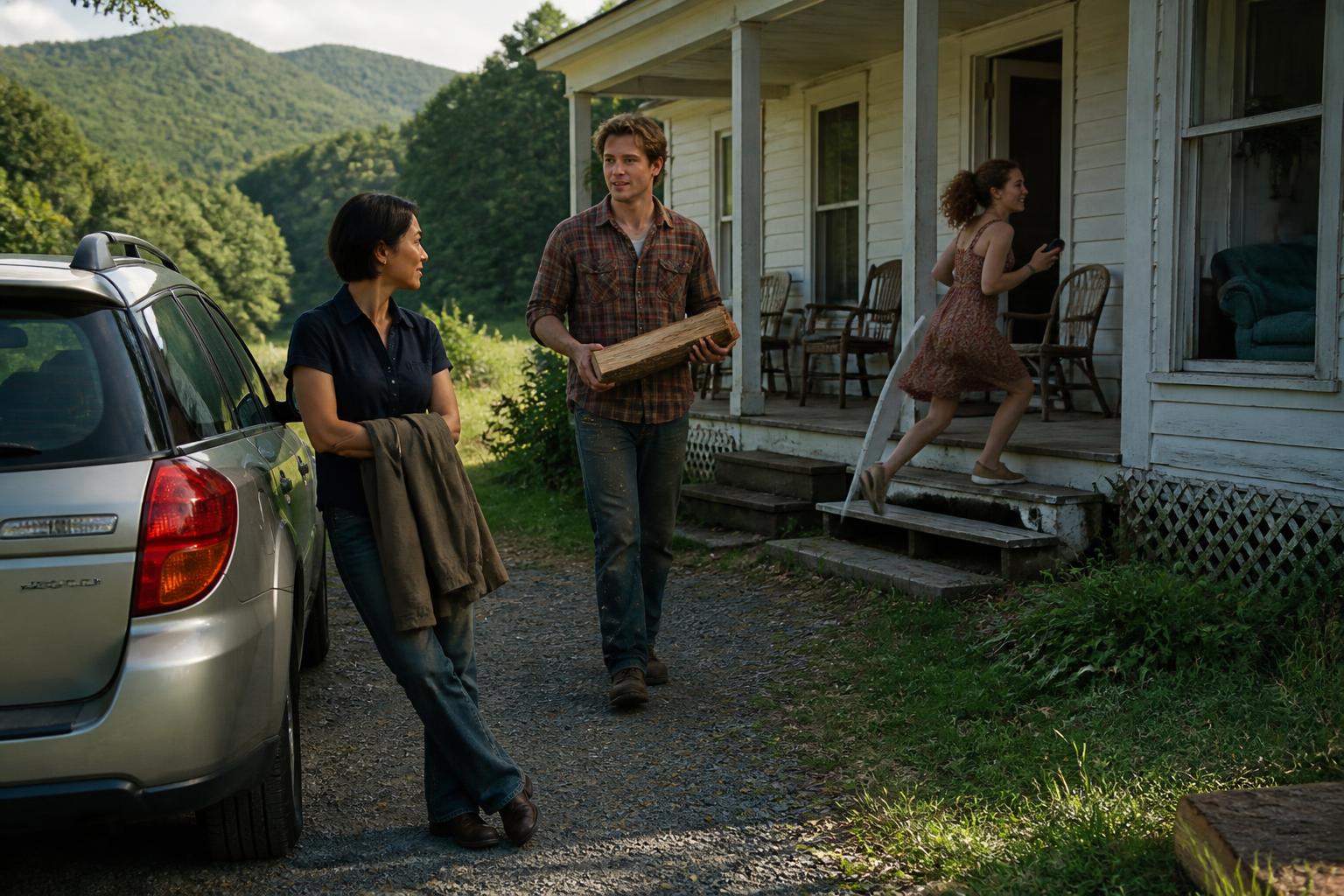
The old farmhouse stood half-shadowed in the afternoon sun, bracketed by the serrated green of summer woods and the distant misty folds of the Blue Ridge. June leaned against her rented Subaru, a city-bought coat slung over her arm despite the mild, humid air. She’d barely closed the trunk on the last of her suitcases before Ben appeared from around the toolshed, carrying a split length of firewood and wearing an expression somewhere between relief and caution.
“Hey,” he said simply.
They hugged—awkwardly, the way siblings do when enough years and trouble have collected between meetings—and June caught the familiar smell of sawdust and pine resin on his shirt. “It looks good, Ben,” she murmured, scanning the porch and the sagging fence line. “Or about as good as it ever did.”
He offered a small smile. “You should see it after a week without rain. Mom’s got me patching every board that even thinks about rotting.”
June followed him inside, shoes squeaking on the old wood floors. The living room was much as she remembered: sun-faded braided rugs, her mother’s blue armchair, family photos on the mantle, and the whirr of the swamp cooler in the window. There was a faint tang of cleaning supplies and something fainter (maybe her mother’s perfume, maybe just old air and memory).
Marissa bounced into the hallway, phone in hand, hair drawn into a loose, impatient ponytail. She wrapped June in a perfumed embrace. “Welcome back to the land of barbecue and bluegrass! Did you get stuck behind a tractor on 191?”
“Only twice,” June said, managing a smile. “I forgot how slow things move here.”
The family dinner that night was lasagna (not the southern pot roast June half-expected), eaten around a table crowded with mismatched chairs. Ben was mostly silent, pushing salad around his plate. Marissa chattered about setting up her classroom at the elementary school, glossing over what sounded suspiciously like nerves. Evelyn watched them all, eyes sharp, hands folded neatly. The silence between her sentences seemed heavier than usual.
At one point, June noticed Evelyn glancing at a small lockbox sitting on the side buffet—a battered thing, dull gray with a dial. Odd. She could not remember seeing it during her childhood summers home from college or even last Thanksgiving, before she’d left for Seattle. Her mother’s gaze lingered, then darted away when June looked up.
Ben excused himself early, claiming a call from a neighbor. Marissa scrolled through her phone, breaking the quiet with sudden laughter at a meme. Evelyn sighed, took their plates, and insisted she didn’t need help washing up. June wandered out onto the broad front porch, the air cooling as the sun dropped into the trees.
A voice called from near the edge of the gravel driveway. Mr. Kersey, their nearest neighbor and something of a fixture, stood out by the mailbox, peering over his glasses.
“Your mama said you’d be back.” He shuffled forward, hands shoved in the pockets of his khaki jacket. “You’re just in time to set things right, June.”
The words snagged her. “You mean around the house?”
But he only smiled, craggy and unreadable. “Everything in its time. Tell Evelyn I said hello.”
June forced a brief laugh, waved, and retreated inside, his odd tone lingering. She told herself he meant nothing—Mr. Kersey always talked in riddles—but a prickle of unease crept up her neck.
The rest of the evening passed quietly. Evelyn made tea. Marissa vanished into her room, murmuring into her phone. Ben banged around the outbuilding. June unpacked in the room she’d claimed at sixteen and found herself lying awake long after midnight, the house settling around her in creaks and shifting boards.
Somewhere down the hall, she heard the softest sounds: her mother crying. Soft, then sharper—a name, whispered and caught:
“Sarah. Not now.”
June stayed very still, listening to the night. The past—whatever shape it took—pressed close on all sides, as if the house itself was waiting for someone to ask the right question.
June woke late, sunlight already a gold stripe across her quilt. She sat up, feeling displaced all over again—her old shelves, stacked with outdated textbooks and the detritus of a teenage life; the clean, uncertain orderliness that telegraphed her mother had rearranged things over the years. She could smell coffee and hear the hum of someone moving around below: life proceeding as though nothing strange had happened.
But the house felt charged. Every floorboard’s groan seemed like a warning. June slipped into jeans and headed down, intent on breakfast, but paused when she noticed the stairs to the attic were ajar. A pale rectangle of light glowed up from above. She frowned and climbed, half expecting to see Ben—except it was Marissa, dusty-kneed and rummaging through cardboard boxes stacked beneath a dormer window.
“What are you looking for?” June asked, standing awkwardly at the threshold. Marissa jumped, knocking her head against an old Christmas wreath. She was biting her lip, cheeks pink in the warm attic gloom.
“Just…old photos. For Mom. She needs one from when Dad still had his mustache. She’s getting sappy about anniversaries.” She dug a little deeper and produced a battered envelope, its edges yellowed. “You can help, if you want. There’s too much junk up here.”
Together, they knelt in the moted sunlight, sifting through ancient yearbooks, brittle event programs, the scattered artifacts of Lowell history. June pulled out a heavy wool scarf and smiled at the memory of snowball fights and runaway sleds. She was reaching for another folder when a slip of glossy paper fell to the floor. Marissa snatched it up, but the image made her freeze in place.
It was a photograph, blurred at the edges but clear enough to show three women—two young, one just older than a girl. Evelyn, with her unmistakable dark hair; beside her, a tall, red-haired woman smiling shyly at the lens; in the center, a baby wrapped in a patterned blanket. Someone had scrawled on the back in pen: Sarah, spring 1986.
June held her breath. Beside her, Marissa stared. “Sarah,” she said. “That’s what Mom was saying last night.”
“She was crying. I heard her.” June brushed a thumb along the photo, unsettled. “Who’s Sarah? And whose baby is this?”
Marissa shook her head, her brow furrowed in a way that made her look much younger. “I’ve never heard Mom talk about a Sarah. Maybe it’s before Ben? I mean, the photo’s from ‘86. That’s two years before Ben was born.”
They exchanged a glance, both uneasy. For as long as they could remember, family history began and ended with what Evelyn allowed them to know—stories filtered through the pleasant fog of nostalgia. There had never been mention of a red-haired woman.
Later that morning, over coffee on the porch while Evelyn showered, June cornered Ben while he was laying out garden tools. She showed him the photo, voice low. “Does this mean anything to you?”
Ben stared long and hard at the image. “Mom gets these letters,” he admitted after a pause. “Every March or April. I’ve seen her sit on the back steps and read them, sometimes crying. She hides them in the lockbox. I never read any—she’d have killed me. But she keeps every envelope.”
Marissa’s eyes widened. “You never asked about it?”
Ben shrugged, looking embarrassed. “Didn’t seem to help if I did. I figure it’s not my business.”
The siblings fell silent, their attention drawn to the house and to the shadow in their mother’s bedroom window. For a moment, June felt the house was smaller than it had ever been, its walls closing in with secrets.
That afternoon, June found herself alone with Evelyn in the kitchen. The hum of the old refrigerator filled the pauses. June set the photo on the table, carefully. “Mom. Who’s Sarah?”
Evelyn’s hand trembled as she pressed it to the table. Her mouth tightened. For several seconds, she said nothing.
“You’ve been digging through things you had no business with,” she said finally, soft but furious. “I told you—I told all of you—to let the past alone.”
June couldn’t help herself: “You were crying about her last night. We found this in the attic. You’ve always said there’s nothing else we should know, but—”
“That’s enough.” Evelyn’s voice rose, and June flinched. “Some things aren’t for you to fix, June. You don’t know what you’re asking.”
The room went silent except for the clatter of Evelyn’s teacup against the sink. She marched out, leaving June staring at the photograph and feeling the cold draft of something breaking wide open between them.
It was Marissa who insisted they needed answers. The next morning, after a breakfast of toast and eggs eaten in pointed silence, she persuaded June and Ben to walk with her out toward the edge of the property. The land sloped gently downward behind the barn, fields narrowing into a line of pines. Mr. Kersey’s house, with its faded green clapboards and unruly hostas, perched in the distance amid stands of goldenrod.
“We need to talk to him,” Marissa said, anxious energy in every gesture. “He’s known Mom since high school. If anyone will say something straight, it’s Mr. Kersey.”
They found him that Saturday morning in his driveway, bent over a jumble of tomato cages. Mr. Kersey straightened up when he saw them, cap squashed low over his careless gray hair. His face, usually creased in mischief, grew grave at the sight of the photograph June held up.
He motioned them onto his shaded porch, poured three cold lemonades, and sat heavily. There was a long moment when his hands rested over his knees and the only sound was a cardinal scolding something from the thicket.
“You found Sarah’s picture, did you?” he said at last. His voice held the abrupt clarity of someone done dodging.
He told the story slowly, as if each memory required careful turning. Sarah was Evelyn’s little sister, wild where Evelyn was steady, flame-haired and quick to laugh, but always drawn back to the Lowells’ weathered farmhouse like a tide. When Sarah was sixteen, she moved into that cottage near the property line—just a few shingled rooms and a porch shaded by sycamores. “Your mother visited Sarah every day after school,” Mr. Kersey said. “Thick as thieves. Sarah idolized her.”
He paused, gaze searching the horizon. “But something happened. I never heard the details. Sarah…she got in trouble, is what folks said. A boy from out of town—nobody local. She had a baby that spring. And then, just like that, she was gone. Sent off to kin in Tennessee. Came back only once, then left for good. Your grandma wouldn’t let Evelyn see her sister for years after that.”
Marissa’s voice was very small. “What happened to the baby?”
Mr. Kersey shook his head. “Adopted out. Some say it was for the best; some still don’t agree. All I know is, your mother never forgave herself for not fighting harder. I’d see Evelyn every spring, staring out past the apple trees, just waiting.”
They walked in silence back to the farmhouse, the truth settling heavy as the humid July air. The sisters sat on the porch steps, knees close, lost in their own thoughts. Ben hovered nearby, arms crossed over his chest. None of them spoke, but the air was different now—cracked open by something real, no longer only suspicion.
Inside, Evelyn’s footsteps were audible in the kitchen. At lunch, she confessed nothing and asked for nothing. The lockbox still glared at them from the sideboard, a mute challenge.
Near dusk, Ben slammed the screen door and spoke, gently but firmly, to his mother as she tended her tomatoes on the back stoop. Marissa stood behind him, quiet but determined.
“We know about Sarah,” Ben said. “About the letters. We found the photo. We’re tired, Mom—we need to understand why you keep all this to yourself.”
Evelyn didn’t flinch this time. She stood, her gloved hands shaking just slightly. After a heavy pause, she beckoned them inside. June and Marissa joined them in the kitchen, the four of them encircled in old linoleum light.
“Sarah was my sister,” Evelyn said at last, voice raw. “Six years younger. When I left for college, she stayed here. That spring, she got pregnant—your grandmother wouldn’t hear of raising the child herself, or letting Sarah keep the baby. There was a family in Kentucky, willing to adopt. I never told a soul, not even your father.”
She glanced at the lockbox; her jaw tensed. “Sarah writes every year. She never married, never had another child. She’s lived out west a long time. For a long while, I thought I was protecting you. Maybe I was only protecting myself.”
Marissa knelt on the linoleum beside her mother, tears quivering on her lashes. “Was she coming back?”
“I always hoped,” Evelyn whispered. “But pride does strange things.”
They clustered together, awkward but united, the air heavy with a sorrow and honesty long postponed. Outside, the dusk smelled of honeysuckle and woodsmoke, everything fragile and unfinished.
The Lowell house felt different in the days that followed, as if the walls themselves were learning new echoes. There was a quietness to mornings but not the brittle sort that followed arguments; instead, it was a softer hush, the kind that accompanies uncertain hope. Evelyn no longer avoided her children’s questions, and June, Ben, and Marissa found themselves working side by side in small, practical ways—scrubbing the porch railings, sorting box after box in the attic, returning some order to the sprawling, half-wild garden. At night, they shared updates around the table about the emails June had begun exchanging with the address Sarah had left on her last letter.
Early on a Sunday, Evelyn placed the battered lockbox in the center of the kitchen table. Marissa opened it—her hands almost reverent—and they sorted through neatly bundled letters, faded blue stationary, photographs of unfamiliar landscapes. There were postcards from Utah, New Mexico, Oregon: Sarah’s spidery handwriting stretching across years, always signed in the same muted hope, Love, your sister, Sarah. A few lines in the most recent letter made June’s heart quicken: My hair’s gone mostly white, but there’s still red if you catch it in the sunlight. I don’t expect you to forgive me, but I miss all the years we lost. If you can find it in your heart, I’d like to see you again before another spring turns. I’ll come if you ask.
They all looked at Evelyn, and she nodded, lips trembling with gratitude and fear. “Let’s invite her,” she said. The message was drafted together—simple and shy, but honest. Ben offered to drive into Asheville for a burner phone so they could call her directly. June typed out a careful email. Marissa pressed send. Every hour for the next two days, Evelyn glanced toward the old clock as if willing the silence to end.
It was a Wednesday, late afternoon, summer’s edge beginning to gild the fields. June stood on the porch steps with Ben and Marissa, a fresh pitcher of iced tea sweating on the rail. Evelyn busied herself with the flowerbeds, hands caked in soil though her gaze kept slipping across the driveway. Then, as the air thickened with the scent of cut grass and impending rain, a nondescript blue sedan rolled to a slow halt beneath the sycamore trees.
For a minute, the world seemed to hold its breath. The car door opened and a woman stepped out—slender, the copper-red hair of old photos now streaked with silver, shoulders rounded by years but dignity intact. She wore jeans and a lavender blouse, and when she straightened, her uncertainty mingled with palpable resolve. Sarah hesitated, then smiled—tentative, a little lost, utterly familiar. Evelyn made a sound like a sob and a laugh tangled together and moved down from the porch across the yard. She stopped short, only feet away. Sarah opened her arms awkwardly, as if remembering long-unused choreography.
There were no grand speeches. Evelyn reached out for her sister, and Sarah let herself be held. The siblings watched, silent, as the two women embraced and time’s old wounds pulsed with sudden tenderness.
Introductions in the kitchen were halting at first. Marissa hovered by the fridge, Ben busied himself with glasses, June made room at the table. Sarah answered questions about her life—small towns, odd jobs, the son she never met who had found his own family. It was not pain-free; there were missed years and words unsaid, and Evelyn wept more than once, but so did Sarah. Marissa squeezed Sarah’s hand and Ben fetched tissues. Time seemed to unwind a little, the knot of the unknown unspooling into story and shared memory.
Night came. A storm kicked up over the mountain, soft thunder rolling across the fields. Everyone lingered together in the living room as rain battered the old roof. There were stories of childhood—Evelyn’s candor meeting Sarah’s laughter, Ben’s reserved humor drawing out smiles. Marissa asked about the baby, and Sarah answered truthfully, voice steady, eyes glistening. It did not undo the past, but it drew them together in its light.
Later, as they washed dishes together, June and Evelyn stood quietly apart. “Thank you for opening the box,” Evelyn said, voice thin but resolute. “I spent so long trying to keep things tidy. All it did was make the ache grow.”
June hugged her mother tight. “We’re still here, Mom. All of us.”
Outside, the air was cleared by rain. The Lowell house was changed—its secrets aired, griefs seen, forgiveness offered but not rushed. They were a family, imperfect but together, roots deepened and tended at last. The mountains watched over them, as always, silent and steadfast.