






Fiction: This is an original fictional story. Characters and events are invented.
Kit Landry didn’t realize how much she depended on her routines until she ran into Karen Burns beside a stack of bruised apples at the H-E-B. It was a Thursday morning, gray and drippy, and Kit had only come in for bread, milk, and the Tums she pretended she didn’t need. She gripped her handbasket tighter as she caught sight of Karen’s profile—a little thinner, hair streaked with ashy gray, her bright wavering voice speaking to the produce clerk like she’d never left Denton at all.
Kit tried to back away, but Karen turned at that precise moment. Recognition fired across her face—alarm, relief, something sharp and hopeful. “Kit?”
Kit brushed a stray brown curl behind her ear, weighing whether to duck behind the display of onions. But homegrown manners were hard to break, even after all these years. “Hey, Karen.”
Their hug was surprisingly automatic; the disconnect came afterward. Ten years ago, they might have fallen into giggling gossip or turned the cart to the bakery together. Now there was just a swirl of memories—marigold-yellow prom dresses, backyard campouts, dozens of sleepy-eyed mornings at Sunflower Florist. Kit tried to smile, but it felt weak as chalk.
Karen bit her lip, glancing skeptically at the apples like the answer might be hidden underneath. “So. I’m back.”
Kit gave a noncommittal nod. “I heard.” Denton spread news the way live oaks shed pollen: everywhere, all at once. Karen’s husband—a man Kit had only met twice—had died suddenly in Houston, and Karen herself had moved into the old family place off Windsor. It was the latest sad thing in a town where sad things didn’t stay secret.
They picked through small talk—Karen’s move (“Still unpacking, boxes everywhere”), Kit’s nothing much (“Just the usual”), bare weather observations (“Spring’s trying, at least”). There was a gulf between them filled with unspoken things—Kit’s closed shop, Karen’s long absence, the birthday cards none of them had sent.
Suddenly, Karen’s voice dropped in pitch. “Kit, um. I need to ask you something.” She seemed to hold her breath a second too long. “I… I know it’s been a while, but I could use some help.”
This startled Kit. “With what?”
“The yard. My yard,” Karen replied, flustered now, her hands fluttering at her heart. “It’s basically a jungle. I’ve got, I don’t know, six-foot weeds and half the front bed’s gone wild. My realtor keeps fussing, but honestly, it’s too much. There’s a home viewing coming up, and I can’t manage it alone.” She hesitated, eyes pleading but ashamed. “Would you come by? Maybe just help me get started?”
Kit’s mouth was dry. She hadn’t set foot in anyone’s garden but her own since the Sunflower closed. Dirt under her nails still made her feel both proud and exposed. But it was Karen—the girl who once taught her to ride a bike, the first person she’d called when Mom passed away.
Kit’s yes came out a whisper: “I could probably spare a morning.”
“Thank you.” Relief shuddered over Karen, brightening her face for the first time since their conversation began. “Saturday? Whenever you can?”
They parted with clumsy promises, bags rustling like apologies. Kit walked home with her mind racing, questioning every word. Saturday arrived too soon, brisk and damp but with a hint of jasmine on the breeze. She steeled herself, gloves in her back pocket, as she crossed Windsor Drive.
Karen’s house was unchanged from the outside, except for the riotous growth choking its porch and sidewalk. Purple vetch wound through forgotten boxwoods, dandelions crowned the grass, and the magnolia tree reached hairy arms over the sagging fence.
Kit hesitated at the gate and nearly turned away, but a muffled bark drew her forward. Another voice called out—Eli, her dependable next-door neighbor, was laying mulch for his elderly mother-in-law across the way. He waved. “Morning, Kit!”
Kit managed a smile she wasn’t sure she felt.
Karen appeared on the porch, bundled against the chill in an Aggie sweatshirt three sizes too big. “Still want to?” she called, voice trembling somewhere between hope and terror.
“Let’s get started,” Kit said, almost steady. She met Karen’s eyes for the first time in years and saw the past, green and tangled, waiting for them to dig in.
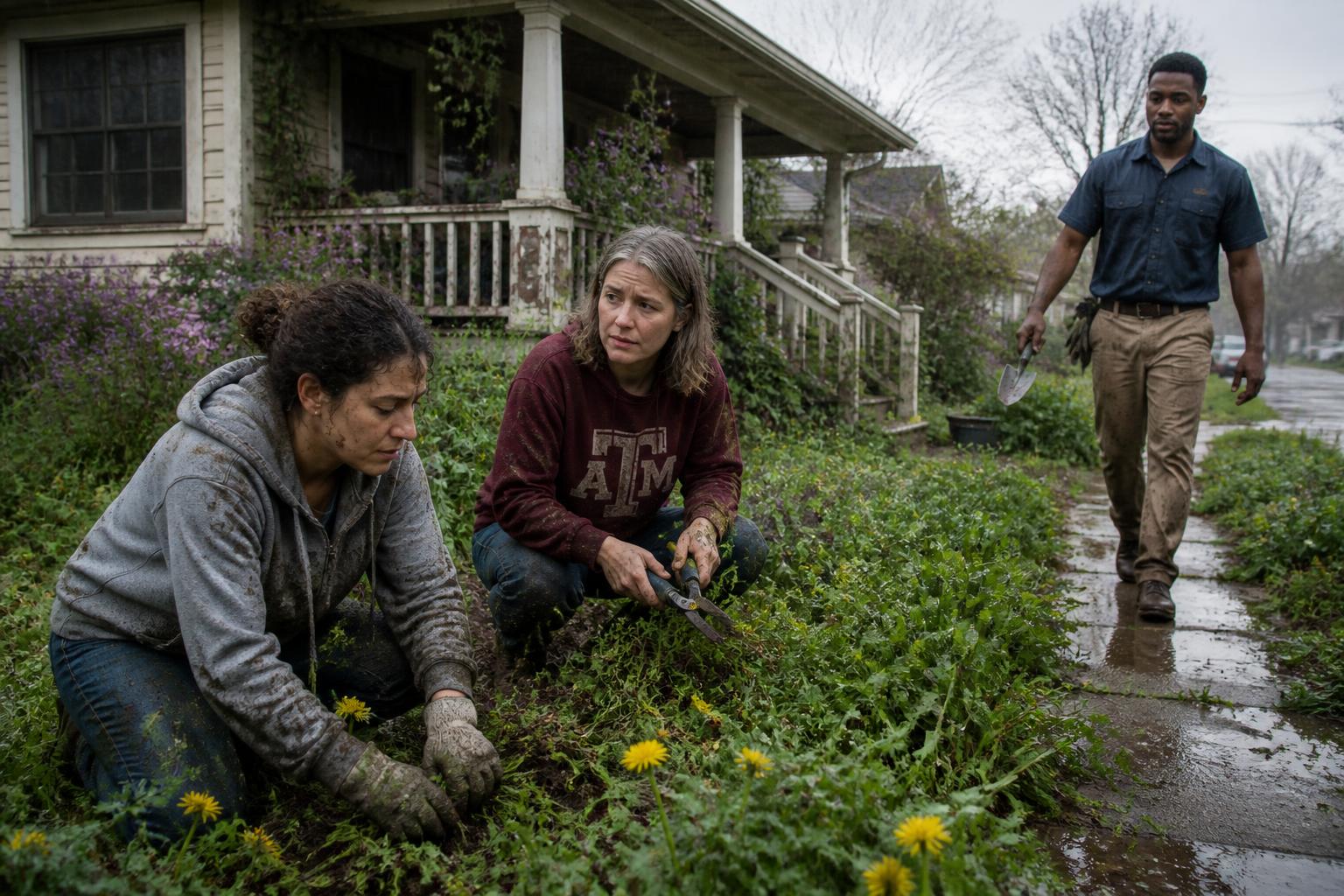
The first hour passed with only the scrape of shovels and the snap of overgrown stems for music. Kit settled into familiar rhythms, loosening soil, clearing tangled runners of honeysuckle from the cracked walk, while Karen attacked the wild patches with garden shears, her breaths fast and uneven. A light northeast drizzle dusted their hair and backs—spring’s tentative blessing—but neither woman seemed to mind. Words hung unsaid, like old sweaters in a closet. Working side by side, Kit sometimes caught Karen watching her as if trying to catch a glimpse of the girl she used to know.
After a while, Eli wandered over from across the street, his work gloves tucked into a belt loop. “Need another pair of hands? I’m between mulch bags,” he offered with a subdued grin. He was younger than Kit by a good dozen years and carried himself with that quiet steadiness people long for in a storm. Kit nodded, grateful for his presence to bridge the awkwardness.
“Here, Eli, see if you can convince these dandelions to surrender,” Kit said, passing him a hand spade. Eli squatted beside the flowerbeds and, in a tone softer than the morning rain, he murmured, “You ladies go way back, don’t you?”
Neither answered at first. Karen broke the silence, voice rough: “We were practically twins when we were kids. Got into all kinds of trouble.” She shot Kit a tentative look, seeking some sign the old mischief could be revisited, but Kit only shrugged, eyes on the roots entangled in her palm.
By midday, they’d unearthed hostas and daylilies half-choked by weeds, filled two contractor bags, and raked the sidewalk clean. Karen retreated to the porch steps, panting, her jeans streaked with mud. Kit peeled off her gloves, flexing her knuckles. There was a pleasant ache of old usefulness beneath the old wariness. Eli dusted his knees, stretching his back, and asked, “Either of y’all want coffee? I can make a pot and bring out whatever’s left of my mom’s banana bread.”
It was the kind of simple kindness that left Kit too surprised to answer. Karen nodded instantly. “That’d be wonderful, Eli, thank you.”
Over styrofoam cups, steam rising in the chilly air, something—if not comfort, then at least an uneasy truce—crept in. Conversation tiptoed back across the years: Karen spoke of Houston’s sharp-edged loneliness, her late husband’s boisterous parties, sleepless nights when she’d imagined never coming home again. Kit listened in careful portions, offering small stories from Denton—the festival’s decline since Sunflower Florist shut its doors, the local bakery that’d replaced her old shop, gossip about familiar names and streets.
But then Karen tried for something lighter: “You know, we always swore we’d wheel out buckets of zinnias and iris for the spring festival one day. Remember our stall plans? I think we even drew up sketches that summer your mom let us take over the backyard.”
Kit flinched, the warmth chilling. She set her cup down, focusing on the pattern of worn boards beneath her feet. “That was a long time ago. I don’t really do flowers anymore.”
“But you could. With me,” Karen insisted, her nervous energy bubbling up. “It doesn’t have to be some big thing. Just a table at the festival. There’s an opening—they’re desperate for vendors this year, I heard. It’d give us something to—”
“No,” Kit said, sharper than intended. “You don’t know what you’re asking, Karen.” She stood, collecting her gloves, unsure why fear tightened her chest. She couldn’t unravel the knot of pride, embarrassment, and the ancient longing to say yes.
Karen’s face fell, uncertainty flickering. Eli watched them both over the rim of his cup, weighing whether to speak. Finally, he murmured, “No rush. Lots of spring left, you know.”
They cleaned up in silence. The yard was better—orderly, if not yet pretty. Kit hesitated at the curb. Karen tried, one more time, to close the gap between them: “I just thought… it might help. For both of us.”
Kit’s voice was quieter now, the old weariness back. “Some things you can’t just fix with flowers, Karen.” She walked away with her gloves clenched and the ghost of home in her wake, leaving Karen staring at a yard full of stubborn green hope.
By Monday, the bright new order of Karen’s yard had faded a little under the drizzle and a restless wind. Kit spent the night after their work staring at her ceiling, replaying the halting invitation to the spring festival. A flurry of old anxieties had bloomed in her chest, each one transplanted from the last bitter days at Sunflower Florist: whispers, pitying looks, rumors she could never quite pin down. She distracted herself with errands and pruning her own reluctant roses—until, just past midnight, her phone buzzed with a text from Eli.
You awake? Cops at Karen's. Something happened.
Kit, heart knocking, rushed to her window. Out on Windsor, blue and red lights spun across Karen’s porch, lighting the battered mailbox and the toppled-for-sale sign. Eli stood in the shadows, arms folded, as two officers took notes while Karen, pale and shivering in her thin robe, pointed toward the garage. Concern prompted Kit outdoors before she could talk herself out of it. The cool air bit her skin as she hurried across the yards.
Inside Karen’s garage, the scene was sharp and ugly: potting soil spilled everywhere, bags slashed open, muddy footprints zigzagging through piles of broken yard tools. On one wall, someone had scrawled in angry, looping spray paint: LIAR.
“I don’t— I haven’t seen anyone, not since we finished work,” Karen was saying, her hands trembling as she tried to explain. She turned, startled to see Kit. For a moment, something like fright flashed across her face—then it softened, vulnerable with relief and old trust.
“I don’t understand—why would anyone do this?” Karen whispered, mostly to herself. The officers promised to look into it, asked if she had enemies. Karen smiled a dazzled, wounded little laugh: “Only my dandelions.”
Kit knelt beside a broken trowel, tracing the thick, wet paint with her eyes. The ugly word swam in her memory—an echo from Denton’s rumor mill all those years ago. Her pulse hammered as she straightened. Karen, catching her gaze, opened her mouth, then closed it with a wince.
After the police left and Eli followed them out, Karen and Kit lingered in the half-cleaned garage. The hush grew oppressive. Karen fiddled with her sleeves, then blurted out, “Kit, I need to say something before you hear it somewhere else.” Her voice shook. “Back when your shop… when it closed, I was going through a divorce that first time. I was so angry at everyone—at myself. And people were talking—about the money, about mistakes with the business. I never set out to hurt you, but I—”
Kit’s jaw tightened. “You what?”
“I overheard Deeann at the bank say you’d bounced checks. That maybe you’d lost track when your mom got sick. I couldn’t believe it. But when folks asked, I didn’t set them straight. I might have even—God, I might have made it sound worse. I thought if I was busy with gossip, no one would look at my mess.” Karen pressed her palms to her eyes, voice dropping. “I’m so sorry, Kit. I barely realized I was doing it ’til someone told me you’d lost your lease.”
The words sat like stones in the silent room. Outside, wind rattled the backyard gate. Kit felt as if old wounds were tearing open—wounds she’d carefully cauterized. “Why didn’t you say something? You never came by. I thought you’d forgotten me.”
“I was ashamed. Then things got complicated. And then it felt…too late.” Karen’s eyes shimmered, brimming with the tears she refused to shed. “This is my fault, isn’t it—the vandalism? It has to be connected. I set things in motion and never tried to stop them.”
Kit’s voice was raw: “People believe what they want. But you were my best friend. All those years, I just—” She broke off, unsure if she was angry or only exhausted. “I can’t fix the past, Karen.”
Just then Eli, who’d lingered in the driveway, ducked his head in. He seemed to read the mood with gentle accuracy. “I heard what happened. Denton's small. Word travels. But sometimes things only fester because nobody talks about them. Maybe what you two need isn’t fixing the yard or painting over a wall. Maybe it’s just… being honest. That’s how you keep something alive, right?”
None of them spoke for a bit, the tension holding firm in the air. Finally, Karen nodded, tears spilling over as she reached for Kit’s hand. “I don’t want to lose you again. I’m sorry. Let me help—however you’ll let me.”
Kit let her fingers be held, shaky and cold. She hadn’t forgiven, exactly, but there was a new, aching possibility, tender as a shoot pushing through earth. In the battered garage, amid broken tools and fresh pain, neither woman looked away.
The days that followed settled into a fragile peace, with no word from the police about the vandalism and no more midnight disruptions. But the air between Kit and Karen was different—tentative, ragged, a little more open. On Wednesday, Kit knocked on Karen’s door with a six-pack of petunias and a thermos of coffee. Even as nerves jittered in her ribs, she forced herself to call out, “We’re going to replant what we lost, all right?” Karen answered with a grateful, tired grin. They didn’t talk about the past much that day, but between the trowel scrapes and the bark of Eli’s old dog, something like their old comfort began to grow back, crooked but sturdy.
Spring waxed brighter and busier. Life in Denton, as always, rolled forward whether anyone was ready or not. At the end of the week, Karen surprised Kit by sliding a folding table and two lawn chairs into the back of her car. “Just in case you say yes about the festival,” she said, not meeting Kit’s eyes. The invitation landed softer now, like an offered hand instead of a challenge. For the first time, Kit didn’t say no outright. She simply shrugged and carried the chairs inside.
On the morning of the festival, Kit stared into her kitchen sink, palms pressed to the rim, letting the nerves rush over her. She didn’t expect to feel ready or triumphant. She didn’t expect to forgive everything or to be forgiven herself. But she pictured the weekend ahead—pocket vases packed with lilac and rosemary, a tablecloth Karen had found in her mother’s attic, Eli volunteering to set up the tent and running extension cords from the coffee shop next to the courthouse square. She pictured laughter, and awkward silences, and maybe a few neighbors who remembered more than they said.
By nine o’clock, their little stall was open. It didn’t look like much: a table dressed in faded blue-and-white, arrangements of thrift-store vases, some posies bundled in brown paper, a handwritten sign—Landry & Burns: Fresh Flowers, Friendship & Forgiveness. Karen made change, bantering with old classmates and an elderly man who swore he remembered Sunflower’s opening day. Kit arranged the bouquets with steady, deliberate hands. A few times she caught people glancing at her with curiosity or even suspicion, but most just smiled and nodded. By noon, they’d sold half the irises, and Kit realized, slightly amazed, that the world hadn’t fallen apart.
Eli showed up mid-morning with coffee and breakfast tacos and stood behind the table while Kit took a break, watching as Karen launched into a story about their junior-high bake sale disaster. Kit returned just in time to join in the laughter—and then, surrounded by blooms that felt neither like armor nor apology, she managed to look Karen in the eye and say, “Thank you. For not giving up. On this, or on me.”
The afternoon passed in a muddle of sunshine and small talk. The line at their stall never grew too long, but Kit caught snippets—someone reminiscing about the old shop, another person quietly telling Karen that Denton was better with her back in it. When the last bouquet was sold, Karen caught Kit in a gentle hug that neither of them needed to explain. The festival had not solved everything. It had, however, offered something bruised and blooming—like an old friendship allowed to root again.
Several weeks later, the three of them—Kit, Karen, and Eli—stood together at the edge of the old community garden off Hickory Street. Sunlight drifted across tidy rows of early tomatoes and squash, the soil dark and fragrant beneath their feet. Kit wiped dirt from her palms and handed Karen a cluster of zinnia seedlings, her face open and easy in a way it hadn’t been for years. “Plant them close,” she said. “Zinnias like the company.”
Eli grinned, dusting his hands on his jeans. There was the familiar hum of bees, the whistle of a train somewhere east, the sound of Karen’s laughter rising and ringing against the soft spring air. Around them, lettuce and onion shoots unfurled, green and fragile. Kit gazed over the tiny garden, her heart thudding with something like hope. Second chances weren’t perfect; neither were friendships. But sometimes, if you risked the work—and let old wounds breathe in the sunlight—things could grow again.
And as Kit pressed her fingers into warm soil, side by side with old friends and new, she understood: forgiveness was never easy, confidence never quick. But the world had not left her behind—not entirely. Here, she could begin again, thing by thing, bloom by bloom.